Short Story Review: “After the Animal Flesh Beings” by Brian Evenson

Tor.com June 21, 2023

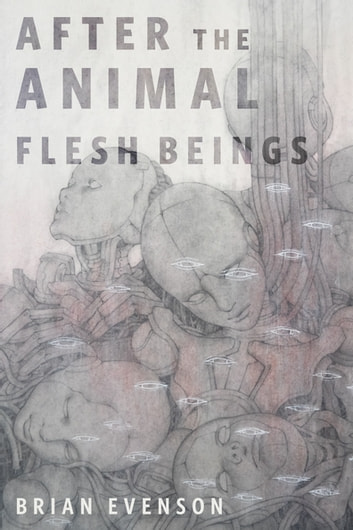
This very short story is set on a post-apocalyptic Earth abandoned by humans and populated by synthetic beings who were left behind. With little information about why they were created and abandoned, their culture is made up entirely of myth and superstition and it quickly becomes clear that their civilization is withering away. I loved so many things about this story; where to start? It is told in five brief, eerie episodes that somehow manage to convey an impression of the entire, tragic history – and longing for a better future that will never come – of this society of slowly corroding robots. The overriding motif of the story is of a damaged “God” that fashions synthetic children from metals torn from the Earth, though these children are barely functional and don’t live long. Evenson’s reputation as a teller of macabre tales especially shines in the one vignette about a human character. The author’s effective use of a collective narrative voice punctuates the overall grimness of the tale. Truly exceptional science fiction.

Hugo 2023 Fiction Finalists – The Reckoning

The Hugo ballot is (finally) here! First, a hearty congratulations to all of the finalists. Everyone on this list works hard at their craft, and at building a loyal fan base, and deserves the recognition they get.

A few months ago when voting for the Hugo Awards began, I posted my predictions for what I thought would appear on the final ballot in the fiction categories and wrote that I would return to the scene of the crime when the finalists were announced to tally my score. I did pretty good overall, except in the short story category. I mention in the previous article that I had no way of knowing how much Chinese voters would affect the outcome, and it turned out that Best Short Story was the place where they made the most difference. I am pleased to be wrong in this case because I was hoping Chinese fans would get their say, and they did.

I said I would also reveal the picks on my own ballot. Now, I have seen over the last fifteen years or so my own tastes and those of the “mainstream” Hugo voters have diverged, but this is the first time in my personal Hugo voting history that not a single work on my ballot was a finalist in the fiction categories. To clarify just how far apart we’ve moved: in 2010, I had 3 novels, 2 novellas, 1 novelette, and 2 short stories from my nominating ballot make the final list. In the 13 years since, I have had only 8 Best Novel nominees on my ballot, and never more than one in a given year; 10 novella nominations, though none since 2020; 8 novelette picks, though not more than one in a single year since 2011 (though two of these were winners, in 2011 and 2016); only 3 short story finalists, and none since 2017 (“That Game We Played During the War”, by Carrie Vaughn). But this year is the first year I’ve ever scored a big fat donut hole in all four categories – though in fairness, as you will see, I predicted as much.

Best Novel

The Finalists
  • The Daughter of Doctor Moreau, by Silvia Moreno-Garcia (Del Rey)
  • The Kaiju Preservation Society, by John Scalzi (Tor Books)
  • Legends & Lattes, by Travis Baldree (Tor Books)
  • Nona the Ninth, by Tamsyn Muir (Tordotcom)
  • Nettle & Bone, by T. Kingfisher (Tor Books)
  • The Spare Man, by Mary Robinette Kowal (Tor Books)
My Predictions (5 out of 6)
  • The World We Make, by N.K. Jemisin (Orbit Books)
  • The Kaiju Preservation Society, by John Scalzi (Tor Books)
  • Legends & Lattes, by Travis Baldree (Tor Books)
  • Nona the Ninth, by Tamsyn Muir (Tordotcom)
  • Nettle & Bone, by T. Kingfisher (Tor Books)
  • The Spare Man, by Mary Robinette Kowal (Tor Books)
My Ballot (0 out of 5)
  • Ymir, by Rich Larson (Orbit Books)
  • 36 Streets, by T.R. Napper (Titan Books)
  • The Dabare Snake Launcher, by Joelle Presby (Baen Books)
  • Eversion, by Alastair Reynolds (Orbit Books)
  • The Court-Martial of the Renegat Renegades, by Kristine Kathryn Rusch (Asimov’s Science Fiction, Sep/Oct – Nov/Dec)

The Daughter of Doctor Moreau is a pleasant surprise. This is Moreno-Garcia’s first Hugo nomination, though she has finished below the cutoff multiple times as an editor and as an author. Her novel Mexican Gothic just missed out in 2021, finishing seventh. It looks as if her Hugo fanbase is growing.

I really didn’t expect anything on my ballot to make the cut. Eversion may have been the only one within throwing distance, tough it’s likely it won’t even appear with the “nominations below cutoff” when the figures are released. Rusch’s novel is my personal favorite. This serialization was very popular with Asimov’s readers, but it doesn’t seem like there are enough of those left in the Hugo voting pool to get anything on the list in any category. Fun fact, the last time a serialized novel was nominated for a Hugo was Rollback by Robert J. Sawyer, which appeared in Analog from October 2006 – January 2007, though it also appeared as a stand-alone book during its eligibility year. The last time a serialized novel was nominated when only appearing as a serial during its eligibility year was Shadrach in the Furnace by Robert Silverberg, which appeared in Analog from August – October 1976. What could have been, if only my fellow Diving Universe fans were Hugo voters.

Best Novella

The Finalists
  • Even Though I Knew the End, by C.L. Polk (Tordotcom)
  • Into the Riverlands, by Nghi Vo (Tordotcom)
  • A Mirror Mended, by Alix E. Harrow (Tordotcom)
  • Ogres, by Adrian Tchaikovsky (Solaris)
  • What Moves the Dead, by T. Kingfisher (Tor Nightfire)
  • Where the Drowned Girls Go, by Seanan McGuire (Tordotcom)
My Predictions (5 out of 6)
  • Even Though I Knew the End, by C.L. Polk (Tordotcom)
  • Into the Riverlands, by Nghi Vo (Tordotcom)
  • A Mirror Mended, by Alix E. Harrow (Tordotcom)
  • A Prayer for the Crown-Shy, by Becky Chambers (Tordotcom)
  • What Moves the Dead, by T. Kingfisher (Tor Nightfire)
  • Where the Drowned Girls Go, by Seanan McGuire (Tordotcom)
    My Ballot (0 out of 5)
    • “Kingsbury 1944”, by Michael Cassutt (Analog, Sep/Oct)
    • The Sins of Our Fathers, by James S.A. Corey (Orbit Books)
    • “Kora is Life”, by David D. Levine (Clarkesworld #188, May)
    • “Polly and (Not) Charles Conquer the Solar System”, by Carrie Vaughn (Clarkesworld #191, Aug)
    • “Communion” by Jay Werkheiser and Frank Wu (Analog, Jan/Feb)

    When making my predictions for this category, I joked “Much like Thanos, Becky Chambers is inevitable and can seemingly conjure up a Hugo nomination with a snap of her fingers. There are none powerful enough to stop her, nor brave enough to try.” So of course she’s the one prediction I got wrong. I have not read Ogres yet but I’m a huge Tchaikovsky fan so I’m looking forward to it.

    The only nomination on my ballot I thought had an outside chance of being a finalist was Sins of our Fathers, an excellent coda to the widely popular Expanse series. The rest were all personal favorites. It’s difficult enough for anything in this category not published by Tor to score a nomination; if your novella is magazine published – even by a (fre)e-zine like Clarkesworld – your chances are diminished even further.

    Best Novelette

    The Finalists
    • “The Difference Between Love and Time”, by Catherynne M. Valente (Someone in Time: Tales of Time-Crossed Romance, Solaris)
    • “A Dream of Electric Mothers”, by Wole Talabi (Africa Risen: A New Era of Speculative Fiction, Tordotcom)
    • “If You Find Yourself Speaking to God, Address God with the Informal You”, by John Chu (Uncanny Magazine, July-August 2022)
    • “Murder By Pixel: Crime and Responsibility in the Digital Darkness”, by S.L. Huang (Clarkesworld, December 2022)
    • “The Space-Time Painter”, by Hai Ya (Galaxy’s Edge, April 2022)
    • “We Built This City”, by Marie Vibbert (Clarkesworld, June 2022)
    My Predictions (3 out of 6)
    • “The Difference Between Love and Time”, by Catherynne M. Valente (Someone in Time: Tales of Time-Crossed Romance, Solaris)
    • “A Dream of Electric Mothers”, by Wole Talabi (Africa Risen: A New Era of Speculative Fiction, Tordotcom)
    • “If You Find Yourself Speaking to God, Address God with the Informal You”, by John Chu (Uncanny Magazine, July-August 2022)
    • “Two Hands, Wrapped in Gold”, by S.B. Divya (Uncanny Magazine May/June)
    • Six Deaths of the Saint, by Alix E. Harrow (Amazon Original Stories)
    • “In Mercy, Rain”, by Seanan Mcguire (Tor.com 7/18)
    My Ballot (0 out of 5)
    • “Solidity”, by Greg Egan (Asimov’s Sep Oct)
    • “Resilience”, by Monalisa Foster (Robosoldiers: Thank You for Your Servos; Baen Books)
    • “Cloudchaser”, by Tom Jolly (Analog Jan/Feb)
    • “The Sadness Box” by Suzanne Palmer (Clarkesworld #190 July)
    • “Necklace of Memory”, by Robert Reed (Asimov’s May/June)

    Five of the finalists were Nebula nominees, while I had predicted four of them to make the grade. One of my Nebula crossover picks didn’t pan out nor did my prediction that Seanan McGuire would score a Wayward Children hat trick this year. We also see the first of the Chinese-language nominees, “The Space-Time Painter” by Hai Ya. I suppose I may have to hit up Google translate when the voter packet comes out.

    Among the novelettes on my ballot, I thought Suzanne Palmer’s “The Sadness Box” had a decent chance of being a finalist, so much so that I considered making it one of my predictions. The unreasonably hopeful part of my brain thinks Egan and Reed always have a chance, even though it has been awhile since either were within arm’s reach of a Hugo.

    Best Short Story

    The Finalists
    • “D.I.Y.”, by John Wiswell (Tordotcom, August 2022)
    • “On the Razor’s Edge”, by Jiang Bo (Science Fiction World, January 2022)
    • “Rabbit Test”, by Samantha Mills (Uncanny Magazine, November-December 2022)
    • “Resurrection”, by Ren Qing (Future Fiction/Science Fiction World, December 2022)
    • “The White Cliff”, by Lu Ban (Science Fiction World, May 2022)
    • “Zhurong on Mars”, by Regina Kanyu Wang (Frontiers, September 2022)
    My Predictions (2 out of 6)
    • “Destiny Delayed”, by Oghenechovwe Donald Ekpeki (Asimov’s May/June)
    • “Give Me English”, by Ai Jiang (F&SF May/June)
    • “Bonsai Starships”, by Yoon Ha Lee (Beneath Ceaseless Skies 2/10)
    • “Skeleton Song”, by Seanan McGuire (Tor.com 10/26)
    • “Rabbit Test”, by Samantha Mills (Uncanny Magazine, November-December 2022)
    • “D.I.Y.”, by John Wiswell (Tordotcom, August 2022)
    My Ballot (0 out of 5)
    • “Beneath the Surface, a Womb of Ice”, by Deborah L. Davitt (Analog Nov/Dec)
    • “Boy in Key of Forsaken”, by Eric Del Carlo (Analog May/June)
    • “Timekeeper’s Symphony”, by Ken Liu (Clarkesworld #192 Sept)
    • “The Empty”, by Ray Nayler (Asimov’s Nov/Dec)
    • “Maximum Efficiency”, by Holly Schofield (Analog Nov/Dec)

    When I wrote that I had no way to predict how Chinese voters would impact the results, this is what I was talking about. At least I scored with the two English language nominees. I am curious to see how close I got with my other predictions when the full details are released in October. For now I’m looking forward to the hastily translated versions of the other stories appearing soon online!

    Ballot-wise, Ken Liu always gets some votes and Ray Nayler has slowly been raising his profile with award voters the last few years, but i still considered their chances distant. My Analog favorites had little chance, but they deserved my vote anyway.

    Final Predictions Score: 63% (15 out of 24)

    Final Ballot Score: 0% (0 out of 20)

    I will revisit these nominees with my reviews of the finalists in the short story and novelette categories at some point in the future. I have read Two of the Best Novel nominees (Moreau and Scalzi) and will try to find the time to read the other four before voting ends. I have not read any of the novella finalists and I will try to work my way through those as well.
    The Hugo 2023 shortlist (or lack thereof) – The Saga Continues

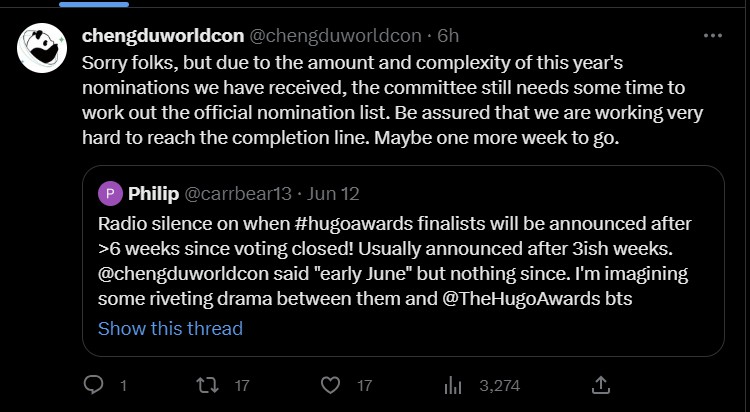
    After missing the “maybe one more week” and “end of June” deadlines, the latest delay in the Hugo shortlist saga involves the erroneous posting of a reportedly early and incorrect version of the shortlist on the Chengdu Worldcon website, which was subsequently taken down with apologies. Before its removal, the false list was reprinted on File 770 and at Camestros Felapton’s website, where it is still available to view. Several congratulations made the rounds on Twitter before the news broke that the list was not the correct one. While the many missed deadlines that have plagued the Hugo voting process this year are frustrating, they are at least understandable considering the dual-language complexities of putting this year’s Worldcon together. This particular error is inexcusable, even if it was an honest mistake. I hope this erroneous list is at least close to the final one when it is eventually released. I noticed at least one problem with the non-shortlist: the Short Story nominee “Upstart” by Lu Ban is actually a 15000 word novelette in English, and it appears the translation is what is meant to be honored, as the original Chinese-language version was published in 2021 and would not be eligible this year. This may be an example of what I spoke of in my previous post on the shortlist delay, where differences in category requirements in China and the US could have been part of the delay in finalizing the list. I do hope that when the actual list is published, this and other Chinese works, creators, and editors are honored alongside the usual suspects, as this non-list suggests they will be.

    Hugo 2023 shortlist announcement delayed for “maybe one more week”

    Chengdu Worldcon has finally given us an update on the Hugo shortlist announcement in the above quote tweet, though I would be surprised if there was any particularly “riveting drama” involved in the delay. Much of the frustration expressed here by Philip (and by many others) is the result of delays in this year’s voting process at the onset, coupled with the infrequency of updates from Worldcon itself. The opening of the nominating phase started much later than US and UK members are used to, with only roughly estimated target dates (much like the “early June” announcement Philip alludes to) to go on, which then passed by without any additional explanation from the committee. I’m sure Chengdu is just as frustrated by the delays as those of us in the states. In this new tweet, at least, there is some clue as to the cause of the delay.

    The “amount and complexity of this year’s nominations” indicates that there may be a considerable number of Chinese works, authors and artists included on this year’s shortlist (I alluded to this possibility when making my predictions for the fiction finalists this year). It’s no secret that Chengdu Worldcon has made a concerted effort to encourage participation from Chinese fans in the nominating phase. The delays in the start of nominations was likely due to producing a unified system that accounted for the needs of both English-speaking and Chinese-speaking voters. I imagine similar issues plague the committee now. In particular, the requirements for the fiction differ somewhat in China from those in the English-speaking world so perhaps there is a need for greater scrutiny of eligibility, with more votes than usual needing to be moved from one category to another. It is also possible that there is some confusion in the eligibility requirements for the fan and professional categories. At the very least, getting the shortlist right and tailoring the announcement to both English-speaking and Chinese-speaking fans would necessitate additional time and resources. This is all speculation, as I don’t have any inside information on the matter, but my best guess is that all the “riveting drama” Philip jokingly imagines taking place is more likely just a bunch of extra headaches the committee is dealing with this year.

    I sincerely hope these delays mean that there will be a number of Chinese authors and works on the shortlist. I have long hoped for greater participation in the Hugo process from non-US fans. There is a large enough contingent of UK-based fans participating from year-to-year to get some (but not many) UK authors on the ballot. African authors, in particular Nigerian authors, have begun appearing on Hugo and other shortlists, but have done so in part because they write primarily in English, and have one less barrier (among many, to be clear) when breaking into American markets than authors who need to have their works translated to English to find a publisher.

    Maybe, if it does turn out that several Chinese-language works end up on the Hugo shortlist, it will jump start a trend of more international participation in Worldcon and the Hugo awards. Or maybe it will just be a one-off and things will go back to normal next year. Either way, I’m more excited to see this year’s shortlist than I have been in awhile. I’ll just have to wait until sometime next week. Possibly. Fingers crossed.

    Novella Review: “The Death Hole Bunker” by Kristine Kathryn Rusch

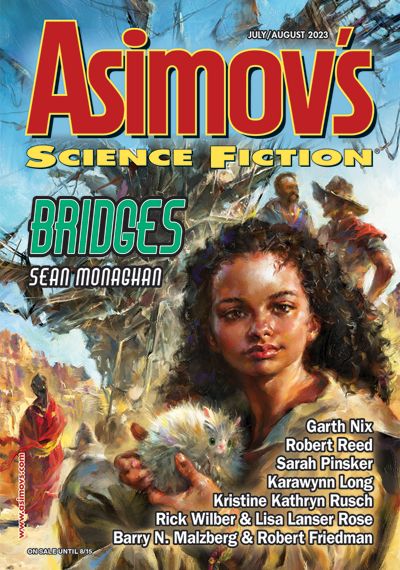
    Asimov’s Science Fiction, July/August 2023

    “The Death Hole Bunker” starts a new storyline in Kristine Katherine Rusch’s Diving Universe, with some fascinating new additions to the mythology. Hogarth is mapping “death holes” that have been appearing underground on the planet Wyr for decades or more. The death holes always have mummified remains in them, and Hogarth always gets an uncomfortable, tingling feeling when he is near one. This time, there is no tingling feeling and he and his partner Raemi find a staircase leading to a series of rooms, suggesting someone once lived there. In one of the rooms is a treasure trove of rare and valuable items known as “ivory trees”, which are neither trees nor made of ivory. Rather they are branch-like objects made of an unknown material that no one has been able to replicate. And there are even stranger mysteries to uncover deeper in the bunker.

    Of all the excellent worlds Rusch has gifted to the world, the Diving stories and novels are probably the most rewarding. This far far future, galaxy-spanning civilization is home to histories and technologies lost to the long march of time, unearthed by people with and incomplete understanding of their application, with often perilous outcomes. “The Death Hole Bunker” is as suspenseful and mysterious as any of the tales that came before. The only drawback is that this is one of those Diving stories meant to part of a longer work, so the long denouement acts a preview of things to come, leaving a lot of questions dangling with no closure for the reader. Of course I plan on reading the promised novel, but for now it leaves me with a tinge of bitterness on the back of my tongue for an otherwise excellent work of science fiction.

    Novelette Review: “Imagine: Purple-Haired Girl Shooting Down the Moon” by Angela Liu

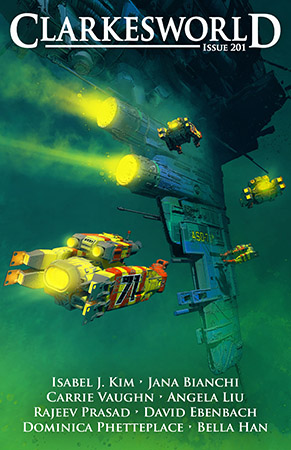
    Clarkesworld #201, June 2023

    I am always intrigued by science fiction stories about art. Especially in the now times, when new technology (NFTs, generative AI) are reshaping our ideas of how art objects will manifest in the future, with all the attending controversies and concerns. AI prompts are a part of what Angela Liu explores in this story (the title itself being one such prompt), but the goings on mostly focus on a technology called “NC orbs”, in which the artist can “paint” fresh memories into the mind of the user. Strapped for cash, the narrator of the story agrees to illegally paint an NC orb for a client of the brothel she sometimes works at, and consequences ensue. Liu has created quite a detailed cyberpunk dystopia here, though one so relentlessly grim it flirts with absurdity. Quite early in the story it is obvious this is all spiraling toward unavoidable tragedy. Despite this, the characters are compelling, and the author’s engagement with the story’s themes coheres quite nicely.

    Short Story Review: “Vast and Trunkless Legs of Stone” by Carrie Vaughn

    Clarkesworld #201, June 2023

    Carrie Vaughn’s latest is a first contact story, one that takes a scenario used hundreds of times before, then adds a rather unusual and ingenious wrinkle that makes for a thoughtful and exciting read. The protagonist, Mal, is chosen for the one-on-one meeting with a representative of a newly arrived alien race known simply as the Mapmakers. Mal is chosen because the Mapmakers insist on meeting with someone who is not in any way a “leader”, and the Mapmaker Summit Committee decided Mal was the best choice because, “she’s kind, she listens, and everyone likes her”. Mal is rehearsed and fed a lot of talking points they want her to cover (the usual stuff about technology, etc.). But the Mapmaker representative has a different idea of how they want the conversation to go. Vaughn, one of the most efficient storytellers in SFF, offers just the right amount of buildup before throwing the reader a curveball, one that is by turns intriguing, understandable, and kind of hilarious. I really enjoyed the effort Mal and the Mapmaker put into trying to have a natural conversation, even while many of the nuances in such an exchange are difficult to delineate. Another excellent story from a genuine pro.

    Short Story Review: “The Officiant” by Dominica Phetteplace

    Clarkesworld #201, June 2023

    “The Officiant” is in some ways an old-fashioned “sensawunda” SF tale, though one tempered by more modern understandings about cultural identity and colonialism. The author has created a vivid and complex world with a fascinating history and mythology. The narrator, a human born to Christian missionaries on the planet Raxia, has come to the planet Tau to officiate a wedding. The narrator quickly learns that the inhabitants of Tau, an enigmatic mechanical race called the Strangers, have a different motive altogether for inviting them there. The strength of the story is the way it gradually deepens our understanding the three cultures and how they view each other and how their competing needs, and mythologies, might set them at odds. Much of how the story unfolds is revealed in interactions between the narrator and the Raxian diplomat who accompanies them to Tau, limiting the amount of tension and excitement the author can build. The plot felt a bit slighter than I hoped it would be, but I would not at all mind seeing this world expanded in a longer work.

    Short Story Review: “Spaceship Joyride” by Dominique Dickey

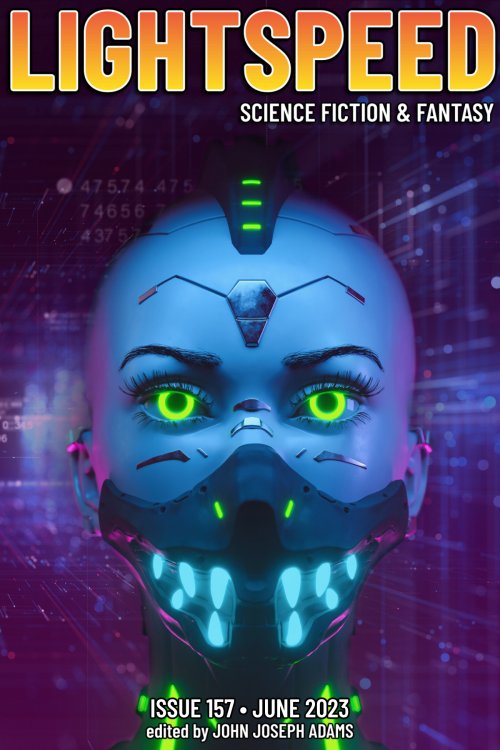
    Lightspeed #157, June 2023

    The first science fiction tale from June’s issue of Lightspeed is a pleasantly written queer coming-of-age story. The protagonist (related in the 2nd person) goes on the titular joyride with classmate crush Eddie, unsure if he is in the friend zone or not. Just as that is about to get cleared up, they are pulled over by a cop, and some mild tension ensues. The story is written in a clear style, and the protagonist and Eddie are both likeable characters. The story is ostensibly SF (spaceships, etc.) but it doesn’t need to be. It could be a story about two kids who hotwire a car and go for a joyride on the highway and it would be the same story with different tropes. As a coming-of-age tale it is well-meaning but nothing really sets it apart.

    36 Streets wins the Aurealis award for best SF novel

    One of my favorite SF novels of last year, 36 Streets by T.R. Napper, won the Aurealis award for best SF novel. If you haven’t read it, do so. It’s a cyberpunk thriller set in a Chinese-occupied Hanoi. In the midst of a turf war between rival crime syndicates, gangster Lin Vu is ordered to find a missing game designer responsible for an addictive VR game called Fat Victory, in which the player lives out the American War in Vietnam as an American soldier. The game is doing a serious number on the brains of people who play it, and Lin’s boss suspects the Chinese army is behind its distribution. The novel is almost wall-to-wall action, but still manages a degree of sophistication akin to the best cyberpunk works of the last few decades. The long sequence in which Lin immerses herself in Fat Victory is visceral and memorable.

    I’ve only read one other work among the Aurealis finalists – the Garth Nix story from Tor.com – but some of the other novels are available on Amazon and a few of the short works are available online. Definitely pick up 36 Streets, but don’t be afraid to dabble in the other finalists as well. Australian SF isn’t terribly well-publicized here in the U.S. and rarely shows up on the Hugo or Nebula shortlists, but it never hurts to see how the other side of the world dreams.

    You can view the full list of Aurealis winners and finalists here.