Short Story Review: “Child of the Mountain” by Gunnar de Winter

Clarkesworld Magazine Issue 220, January 2025 /Story Link/

Chime is a bioengineered, possibly immortal child who serves the sisters of a religious order on a remote mountain. Chime is tasked with initiating the resurrection of each sister after death, by retrieving a “seed” from their skulls once the vultures have picked their bones clean. Chime then regrows the sister’s nervous system and places it in a printed body. However, over the years, Chime has developed her own ideas on how best to advance the order’s goals.

This is dark and bloody dystopian SF, though maybe not quite horror. The descriptive language is excellent, if grisly. I was curious about the guiding philosophy of the sisters, but scant evidence beyond a few suggestive allusions is present. This vagueness of purpose colored by reaction to the story, and to the decisions Chime makes. There is a reference to an “infinite wheel”, suggesting the cycle of death and resurrection is central to whatever it is they are devoted to. Otherwise, if the sisters are capable of creating an immortal body like Chime’s, why not resurrect themselves into one after death? The sister’s seem content to observe world calamity from their perch and do nothing about it, so perhaps the author is suggesting that religious devotion is self -indulgent and regressive. This begs the question of what Chime expects to achieve by changing the rules of the game. The ending suggests that Chime will “do more than observe” but still with little indication of her ultimate goals. It left a bit of a sour taste in my mouth.
Novelette Review: “Strange Events at Fletcher and Front!” by Tom R. Pike

Analog Science Fiction & Fact, January/February 2025

George is an inventor in early 20th century New York. When the novelette opens, he is being chased by thugs he is certain were sent by one of the big energy barons (Rockefeller, Edison, or Frick) to abduct him. Just as the out-of-shape George runs out of steam, a strange, masked “intervenor” appears through a strange door and dispatches George’s would be abductors, using an impossible, futuristic energy weapon. Being a fan of H.G. Wells, George believes the intervenor to be a time traveler from the future. But has this person from the future prevented George’s abduction with good or evil intent? When George reads an obscure article suggesting that burning fossil fuels could have an adverse effect on global temperatures, he believes his rescuer meant for him to continue developing his “solar power generator” for mass production.

This is the second story in this issue of Analog, and the second to concern itself with climate change. I like that many such solution-based approaches to the subject matter are becoming commonplace in our oldest continuous science fiction publication. As for the story itself, it is of adequate quality: good character work, clear and concise prose, steady pacing. While plenty of obstacles in George’s way are referenced as the story progresses, we actually see little of it in action. The result is a story with a lot of conflict but little tension. While we might presume the mysterious time traveler achieved their goal, they never reappear, and the open ending perhaps suggests the author could revisit this alternate timeline in a future tale.

Short Story Review: “Our Lady of the Gyre” by Doug Franklin

Analog Science Fiction and Fact, January/February 2025

Mel, who narrates the story, sails a ship around the Pacific that submerges captured carbon in the ocean in the form of diatoms. The “Lady” referred to in the title is an orbiting artificial intelligence who sends warnings about potential weather disasters. Years before, Mel’s wife was killed during one such disaster. Now, another weather event looms just as Mel takes on two young deck hands to help on his latest drift around the gyre (a ring-like rotation of ocean currents).

There is quite a lot going on in the world of this story, and the way the author gradually broadens the scope and scale of its background is the story’s best attribute. Our Lady of the Gyre is one of several AIs that take on a mythological importance in this future, and are frequently the subject of poetry and performance art, a detail I enjoyed a great deal. The narrator also refers to a sort of information chaos brought on by a reliance on generative AI, making it difficult for society to distinguish between fact and falsehood, and I wish the author had utilized this idea a little more than he did. The characters are agreeable and well-drawn and the plot moves along at a steady clip, though is a little light on suspense and surprise.

Short Story Review: “When There Are Two of You: A Documentary” by Zun Yu Tan

Clarkesworld Issue 220, January 2025 (Story Link)

As the title suggests, this short story is structured as a series of interviews. The interviewees are all people who use, or have used, a new technology called Sentience, which is literally a digital copy of yourself, implanted in your own head to help make you a better you. The two main interviewees are Walter Lee II, the first Android built to house a sentience, who continues on after his original self dies; and Joyce Chu, who comes to believe her Sentience may not have all the answers.

This loosely structured story is surprisingly light on tension, especially considering the premise seems built for it. The final decisions that Walter II and Joyce make are understandable, but not surprising or particularly bold. Despite the intriguing concept, the whole package didn’t quite gel for me. Joyce’s final choice regarding her Sentience made me wonder if her Sentience was really the problem. It’s hard to be sure if that was the point.

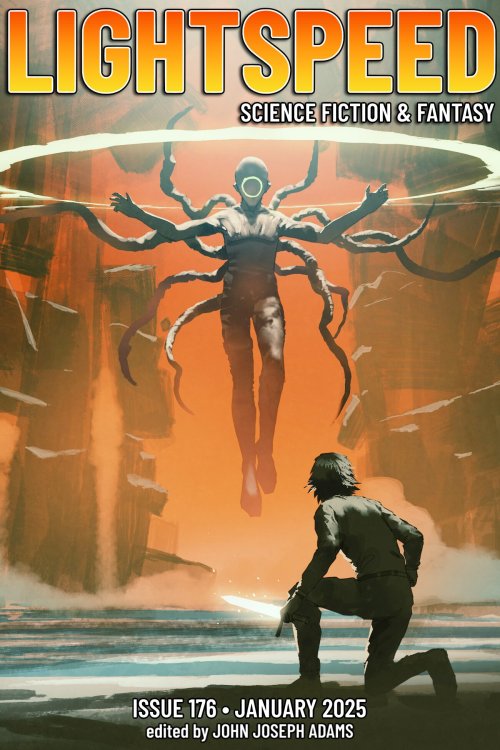
Short Story Review: “Tell Them a Story to Teach Them Kindness” by B. Pladek

Lightspeed Magazine Issue 176, January 2025 (Story Link)

Jude is working as a “Curator” for the Milwaukee school district, assigned to prompt new stories using an AI called RIGHTR. RIGHTR is designed to create stories that offer moral instruction without offending anyone. On a whim, Jude decides to send a 10th grade teacher a story written by a human author (Le Guin’s “Omelas”), assuming – correctly – that like most people this teacher, Booker, has never read a real book and wouldn’t know what it was. The story is a hit with the kids and Jude keeps passing off human-authored stories as RIGHTR-authored prompts. The ruse works brilliantly, until it doesn’t.

The story is framed as a series of messages between Jude and Booker (as well as other’s in Jude’s orbit) and I felt this was a good format for telling this particular story. The contrast between the distinctive voices of the characters and the impersonal delivery mechanism is effective, and on-theme. The point of the story is to dramatize our present-day anxieties regarding the use of AI, as well as the alarming trend among parents (and increasingly compliant school boards) to censor anything that might “upset” their children. This story works well in fulfilling this objective, and Jude’s misconception about what made his deception successful is heartbreaking. However, in the end the story does not ask anything more of the reader than to agree with its own moral purpose. Ironic, if unintended.

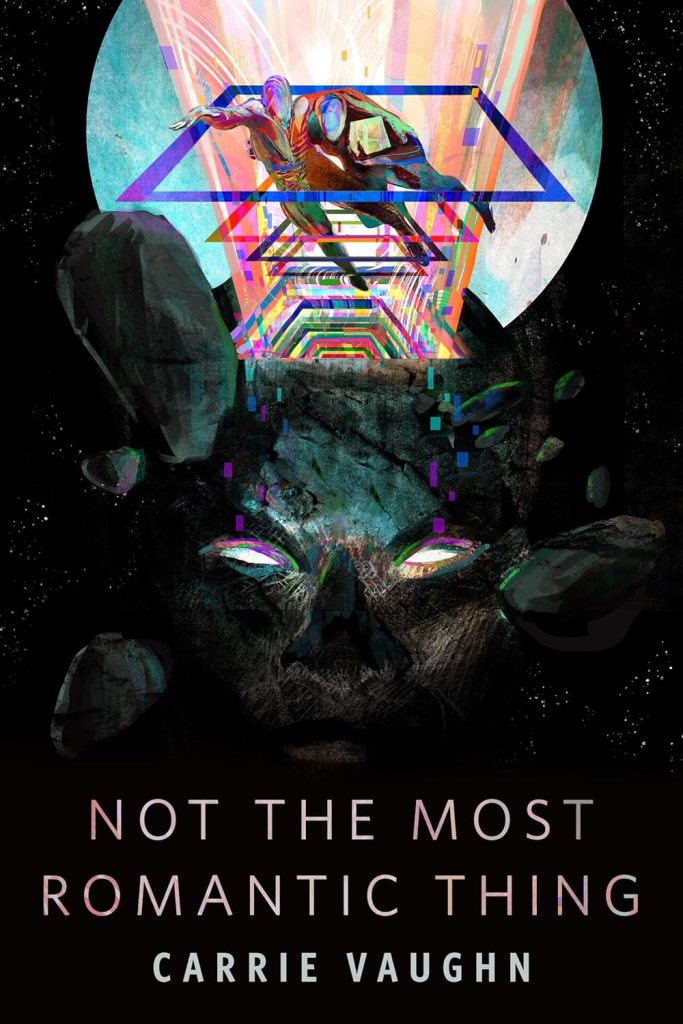
Short Story Review: “Not the Most Romantic Thing” by Carrie Vaughn

Tor.com, October 11, 2023

Not the Most Romantic Thing” is the fourth of Vaughn’s stories set on the bounty-hunting ship Visigoth. It is the most light-hearted and (despite the title) romantic of the tales. Set much earlier in the timeline than the other stories, it relates Graff and Ell’s first mission together when their relationship was just blossoming. This time the Visigoth is hired to extract tissue samples from a defunct lab on an asteroid scheduled for demolition. Things go sideways when the “tissue samples” give the two men a little more trouble than expected and they run the risk of missing their window to flee before the asteroid gets mulched.

The story is structured as a flashback narrated by the illegally post-human Graff, whose enhancements give him perfect recall. As such, Vaughn doesn’t bother exploiting the story’s built-in countdown clock in order to ratchet up the suspense – Graff has already indicated at the start they will make it through alive, even if readers of the previous stories need no such prompt. The story concludes in the “present”, with the two lovers remarking on that long ago mission with particular attention to a detail that could have given away the secret Graff was (at the time) so terrified of letting out. In this way the story plays as something of a postscript to its tenser, heavier-themed predecessors; a “look where we’re at now” coda to the story so far. It’s a nice addition that works best for readers who have already been following the series, though I’d be lying if I said I wouldn’t prefer the author to turn it back up to 11 the next time around.

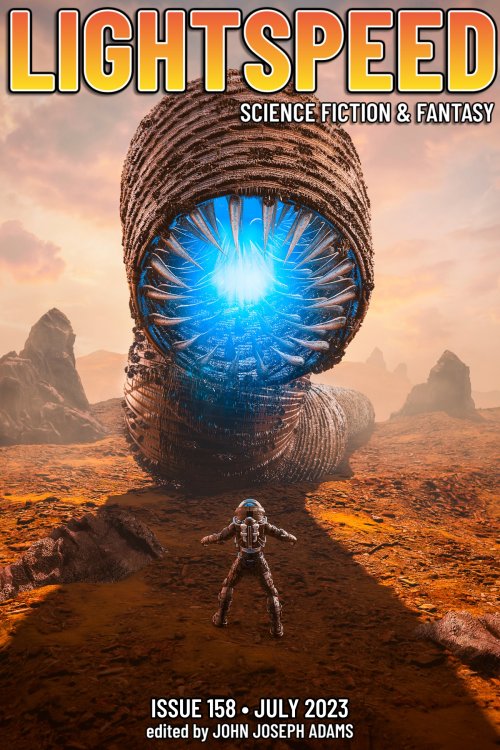
Short Story Review: “Death is Better” by Oluwatomiwa Ajeigbe

Lightspeed Issue 158, July 2023

The narrator of this story is trying – along with his little sister – to escape the alien slavers they were sold to by their own uncle, knowing that if they are caught the penalty is death. As the title of the story suggests, this would not be the worst outcome. This is a very short, relentlessly grim tale, but the author has a gift for building suspense and writing an exciting action scene. I thought the ending was a bit of a cheat (though it certainly fits with the story’s title/theme) and I could have used more engagement with the setting, but it is a well-written and exciting story nonetheless.

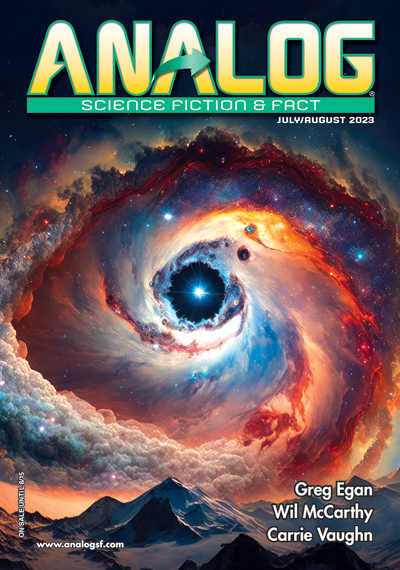
Novelette Review: “Didicosm” by Greg Egan

Analog Science Fiction and Fact, July/August 2023

When she was a child, Charlotte’s father committed suicide, unable to cope with his wife’s death. His actions were largely motivated by a pop-science author’s views on the structure of the universe. As an adult scientist, Charlotte dedicates her research to disproving that author’s theories.

Egan dramatizes a real-life theoretical debate over the shape of the universe, regarding orientable and non-orientable kinds of three-dimensional space. Charlotte is a compelling and relatable protagonist with noble, if also a little selfish, personal goals. This is also one of those Egan stories where the author leaps down a mathematical rabbit-hole (complete with 3D diagrams), and the reader’s level of enjoyment is likely to depend on one’s love of geometry relative to the author’s. Still, “Didicosm” is a solid story, if not among Egan’s very best.

Egan offers an even more thorough – if occasionally head-spinning – account of what a didicosm is on his website, for those interested in further understanding the concept.

Novelette Review: “Showdown on Planetoid Pencrux” by Garth Nix

Asimov’s Science Fiction, July/August 2023

Like most SF/Western hybrids, Garth Nix attempts to mash together a variety of tropes and cliches from both genres in clever and amusing ways. For this reader, the results are mixed. The main characters are Uncia and Onca, a Sheriff and Deputy maintaining order in a small mining town on a planet outside the jurisdiction of the galaxy-dominating Federation. They are part-cybernetic beings known as “warborgs” who fought for the Hegemony against the Federation during a devastating war that the Hegemony lost. Now all warborgs are illegal under Federation law. Atrox, a sadistic warborg repurposed by the Federation to hunt down its own kind (and any humans unwilling to fall in line) has arrived to destroy Uncia and Onca and bring the planet under Federation heel.

Nix offers up a very detailed sandbox to play in, and that ends up being a double-edged sword. As fun as the setting and backstory can be, for the first two-thirds of the novelette the characters can hardly take a step or get off a line of dialogue without the author digressing into several paragraphs of exposition. The story is nearly half-finished before the main conflict is even established. This has the unfortunate effect of making the promised “showdown” feel somewhat hasty in its execution. Uncia and Onca are nicely delineated characters, though, and their relationship allows for a satisfyingly tender conclusion.

Novelette Review: “Detonation Boulevard” by Alastair Reynolds

Tor.com July 12, 2023

Cat Catling is one of the top rally racers in the solar system, but she’s never won the course on the treacherous terrain of the Jovian moon Io. She hopes to change that this time around, but her rival Zimmer – who wins every year – stands in her way. The two hold a wide lead over the rest of the pack when Zimmer decides to take his car through a deadly, geyser-strewn stretch of the course known as Detonation Boulevard. Cat makes the split second decision to follow him. What happens there takes everything she thought she knew about her life and career and turns it on its head.

It’s unusual to describe a story that runs on near non-stop action as “character-driven”, but that’s what we have here. Reynolds plies us with the usual sports story sentiments like honor and glory and guts, etc., then offers us a more sinister take on the demands such competitions can make on the minds and bodies of the participants. It all ends on a jarringly cynical note that took a minute for me to digest, but I see now it was the right choice to make for this story. (p.s. nice shout out to The Sisters of Mercy)