Hugo 2023 Fiction Finalists – The Reckoning

The Hugo ballot is (finally) here! First, a hearty congratulations to all of the finalists. Everyone on this list works hard at their craft, and at building a loyal fan base, and deserves the recognition they get.

A few months ago when voting for the Hugo Awards began, I posted my predictions for what I thought would appear on the final ballot in the fiction categories and wrote that I would return to the scene of the crime when the finalists were announced to tally my score. I did pretty good overall, except in the short story category. I mention in the previous article that I had no way of knowing how much Chinese voters would affect the outcome, and it turned out that Best Short Story was the place where they made the most difference. I am pleased to be wrong in this case because I was hoping Chinese fans would get their say, and they did.

I said I would also reveal the picks on my own ballot. Now, I have seen over the last fifteen years or so my own tastes and those of the “mainstream” Hugo voters have diverged, but this is the first time in my personal Hugo voting history that not a single work on my ballot was a finalist in the fiction categories. To clarify just how far apart we’ve moved: in 2010, I had 3 novels, 2 novellas, 1 novelette, and 2 short stories from my nominating ballot make the final list. In the 13 years since, I have had only 8 Best Novel nominees on my ballot, and never more than one in a given year; 10 novella nominations, though none since 2020; 8 novelette picks, though not more than one in a single year since 2011 (though two of these were winners, in 2011 and 2016); only 3 short story finalists, and none since 2017 (“That Game We Played During the War”, by Carrie Vaughn). But this year is the first year I’ve ever scored a big fat donut hole in all four categories – though in fairness, as you will see, I predicted as much.

Best Novel

The Finalists
  • The Daughter of Doctor Moreau, by Silvia Moreno-Garcia (Del Rey)
  • The Kaiju Preservation Society, by John Scalzi (Tor Books)
  • Legends & Lattes, by Travis Baldree (Tor Books)
  • Nona the Ninth, by Tamsyn Muir (Tordotcom)
  • Nettle & Bone, by T. Kingfisher (Tor Books)
  • The Spare Man, by Mary Robinette Kowal (Tor Books)
My Predictions (5 out of 6)
  • The World We Make, by N.K. Jemisin (Orbit Books)
  • The Kaiju Preservation Society, by John Scalzi (Tor Books)
  • Legends & Lattes, by Travis Baldree (Tor Books)
  • Nona the Ninth, by Tamsyn Muir (Tordotcom)
  • Nettle & Bone, by T. Kingfisher (Tor Books)
  • The Spare Man, by Mary Robinette Kowal (Tor Books)
My Ballot (0 out of 5)
  • Ymir, by Rich Larson (Orbit Books)
  • 36 Streets, by T.R. Napper (Titan Books)
  • The Dabare Snake Launcher, by Joelle Presby (Baen Books)
  • Eversion, by Alastair Reynolds (Orbit Books)
  • The Court-Martial of the Renegat Renegades, by Kristine Kathryn Rusch (Asimov’s Science Fiction, Sep/Oct – Nov/Dec)

The Daughter of Doctor Moreau is a pleasant surprise. This is Moreno-Garcia’s first Hugo nomination, though she has finished below the cutoff multiple times as an editor and as an author. Her novel Mexican Gothic just missed out in 2021, finishing seventh. It looks as if her Hugo fanbase is growing.

I really didn’t expect anything on my ballot to make the cut. Eversion may have been the only one within throwing distance, tough it’s likely it won’t even appear with the “nominations below cutoff” when the figures are released. Rusch’s novel is my personal favorite. This serialization was very popular with Asimov’s readers, but it doesn’t seem like there are enough of those left in the Hugo voting pool to get anything on the list in any category. Fun fact, the last time a serialized novel was nominated for a Hugo was Rollback by Robert J. Sawyer, which appeared in Analog from October 2006 – January 2007, though it also appeared as a stand-alone book during its eligibility year. The last time a serialized novel was nominated when only appearing as a serial during its eligibility year was Shadrach in the Furnace by Robert Silverberg, which appeared in Analog from August – October 1976. What could have been, if only my fellow Diving Universe fans were Hugo voters.

Best Novella

The Finalists
  • Even Though I Knew the End, by C.L. Polk (Tordotcom)
  • Into the Riverlands, by Nghi Vo (Tordotcom)
  • A Mirror Mended, by Alix E. Harrow (Tordotcom)
  • Ogres, by Adrian Tchaikovsky (Solaris)
  • What Moves the Dead, by T. Kingfisher (Tor Nightfire)
  • Where the Drowned Girls Go, by Seanan McGuire (Tordotcom)
My Predictions (5 out of 6)
  • Even Though I Knew the End, by C.L. Polk (Tordotcom)
  • Into the Riverlands, by Nghi Vo (Tordotcom)
  • A Mirror Mended, by Alix E. Harrow (Tordotcom)
  • A Prayer for the Crown-Shy, by Becky Chambers (Tordotcom)
  • What Moves the Dead, by T. Kingfisher (Tor Nightfire)
  • Where the Drowned Girls Go, by Seanan McGuire (Tordotcom)
    My Ballot (0 out of 5)
    • “Kingsbury 1944”, by Michael Cassutt (Analog, Sep/Oct)
    • The Sins of Our Fathers, by James S.A. Corey (Orbit Books)
    • “Kora is Life”, by David D. Levine (Clarkesworld #188, May)
    • “Polly and (Not) Charles Conquer the Solar System”, by Carrie Vaughn (Clarkesworld #191, Aug)
    • “Communion” by Jay Werkheiser and Frank Wu (Analog, Jan/Feb)

    When making my predictions for this category, I joked “Much like Thanos, Becky Chambers is inevitable and can seemingly conjure up a Hugo nomination with a snap of her fingers. There are none powerful enough to stop her, nor brave enough to try.” So of course she’s the one prediction I got wrong. I have not read Ogres yet but I’m a huge Tchaikovsky fan so I’m looking forward to it.

    The only nomination on my ballot I thought had an outside chance of being a finalist was Sins of our Fathers, an excellent coda to the widely popular Expanse series. The rest were all personal favorites. It’s difficult enough for anything in this category not published by Tor to score a nomination; if your novella is magazine published – even by a (fre)e-zine like Clarkesworld – your chances are diminished even further.

    Best Novelette

    The Finalists
    • “The Difference Between Love and Time”, by Catherynne M. Valente (Someone in Time: Tales of Time-Crossed Romance, Solaris)
    • “A Dream of Electric Mothers”, by Wole Talabi (Africa Risen: A New Era of Speculative Fiction, Tordotcom)
    • “If You Find Yourself Speaking to God, Address God with the Informal You”, by John Chu (Uncanny Magazine, July-August 2022)
    • “Murder By Pixel: Crime and Responsibility in the Digital Darkness”, by S.L. Huang (Clarkesworld, December 2022)
    • “The Space-Time Painter”, by Hai Ya (Galaxy’s Edge, April 2022)
    • “We Built This City”, by Marie Vibbert (Clarkesworld, June 2022)
    My Predictions (3 out of 6)
    • “The Difference Between Love and Time”, by Catherynne M. Valente (Someone in Time: Tales of Time-Crossed Romance, Solaris)
    • “A Dream of Electric Mothers”, by Wole Talabi (Africa Risen: A New Era of Speculative Fiction, Tordotcom)
    • “If You Find Yourself Speaking to God, Address God with the Informal You”, by John Chu (Uncanny Magazine, July-August 2022)
    • “Two Hands, Wrapped in Gold”, by S.B. Divya (Uncanny Magazine May/June)
    • Six Deaths of the Saint, by Alix E. Harrow (Amazon Original Stories)
    • “In Mercy, Rain”, by Seanan Mcguire (Tor.com 7/18)
    My Ballot (0 out of 5)
    • “Solidity”, by Greg Egan (Asimov’s Sep Oct)
    • “Resilience”, by Monalisa Foster (Robosoldiers: Thank You for Your Servos; Baen Books)
    • “Cloudchaser”, by Tom Jolly (Analog Jan/Feb)
    • “The Sadness Box” by Suzanne Palmer (Clarkesworld #190 July)
    • “Necklace of Memory”, by Robert Reed (Asimov’s May/June)

    Five of the finalists were Nebula nominees, while I had predicted four of them to make the grade. One of my Nebula crossover picks didn’t pan out nor did my prediction that Seanan McGuire would score a Wayward Children hat trick this year. We also see the first of the Chinese-language nominees, “The Space-Time Painter” by Hai Ya. I suppose I may have to hit up Google translate when the voter packet comes out.

    Among the novelettes on my ballot, I thought Suzanne Palmer’s “The Sadness Box” had a decent chance of being a finalist, so much so that I considered making it one of my predictions. The unreasonably hopeful part of my brain thinks Egan and Reed always have a chance, even though it has been awhile since either were within arm’s reach of a Hugo.

    Best Short Story

    The Finalists
    • “D.I.Y.”, by John Wiswell (Tordotcom, August 2022)
    • “On the Razor’s Edge”, by Jiang Bo (Science Fiction World, January 2022)
    • “Rabbit Test”, by Samantha Mills (Uncanny Magazine, November-December 2022)
    • “Resurrection”, by Ren Qing (Future Fiction/Science Fiction World, December 2022)
    • “The White Cliff”, by Lu Ban (Science Fiction World, May 2022)
    • “Zhurong on Mars”, by Regina Kanyu Wang (Frontiers, September 2022)
    My Predictions (2 out of 6)
    • “Destiny Delayed”, by Oghenechovwe Donald Ekpeki (Asimov’s May/June)
    • “Give Me English”, by Ai Jiang (F&SF May/June)
    • “Bonsai Starships”, by Yoon Ha Lee (Beneath Ceaseless Skies 2/10)
    • “Skeleton Song”, by Seanan McGuire (Tor.com 10/26)
    • “Rabbit Test”, by Samantha Mills (Uncanny Magazine, November-December 2022)
    • “D.I.Y.”, by John Wiswell (Tordotcom, August 2022)
    My Ballot (0 out of 5)
    • “Beneath the Surface, a Womb of Ice”, by Deborah L. Davitt (Analog Nov/Dec)
    • “Boy in Key of Forsaken”, by Eric Del Carlo (Analog May/June)
    • “Timekeeper’s Symphony”, by Ken Liu (Clarkesworld #192 Sept)
    • “The Empty”, by Ray Nayler (Asimov’s Nov/Dec)
    • “Maximum Efficiency”, by Holly Schofield (Analog Nov/Dec)

    When I wrote that I had no way to predict how Chinese voters would impact the results, this is what I was talking about. At least I scored with the two English language nominees. I am curious to see how close I got with my other predictions when the full details are released in October. For now I’m looking forward to the hastily translated versions of the other stories appearing soon online!

    Ballot-wise, Ken Liu always gets some votes and Ray Nayler has slowly been raising his profile with award voters the last few years, but i still considered their chances distant. My Analog favorites had little chance, but they deserved my vote anyway.

    Final Predictions Score: 63% (15 out of 24)

    Final Ballot Score: 0% (0 out of 20)

    I will revisit these nominees with my reviews of the finalists in the short story and novelette categories at some point in the future. I have read Two of the Best Novel nominees (Moreau and Scalzi) and will try to find the time to read the other four before voting ends. I have not read any of the novella finalists and I will try to work my way through those as well.
    The Hugo 2023 shortlist (or lack thereof) – The Saga Continues

    After missing the “maybe one more week” and “end of June” deadlines, the latest delay in the Hugo shortlist saga involves the erroneous posting of a reportedly early and incorrect version of the shortlist on the Chengdu Worldcon website, which was subsequently taken down with apologies. Before its removal, the false list was reprinted on File 770 and at Camestros Felapton’s website, where it is still available to view. Several congratulations made the rounds on Twitter before the news broke that the list was not the correct one. While the many missed deadlines that have plagued the Hugo voting process this year are frustrating, they are at least understandable considering the dual-language complexities of putting this year’s Worldcon together. This particular error is inexcusable, even if it was an honest mistake. I hope this erroneous list is at least close to the final one when it is eventually released. I noticed at least one problem with the non-shortlist: the Short Story nominee “Upstart” by Lu Ban is actually a 15000 word novelette in English, and it appears the translation is what is meant to be honored, as the original Chinese-language version was published in 2021 and would not be eligible this year. This may be an example of what I spoke of in my previous post on the shortlist delay, where differences in category requirements in China and the US could have been part of the delay in finalizing the list. I do hope that when the actual list is published, this and other Chinese works, creators, and editors are honored alongside the usual suspects, as this non-list suggests they will be.

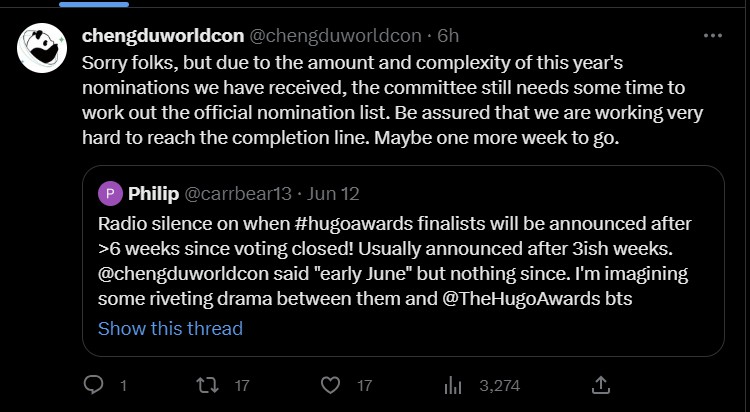
    Hugo 2023 shortlist announcement delayed for “maybe one more week”

    Chengdu Worldcon has finally given us an update on the Hugo shortlist announcement in the above quote tweet, though I would be surprised if there was any particularly “riveting drama” involved in the delay. Much of the frustration expressed here by Philip (and by many others) is the result of delays in this year’s voting process at the onset, coupled with the infrequency of updates from Worldcon itself. The opening of the nominating phase started much later than US and UK members are used to, with only roughly estimated target dates (much like the “early June” announcement Philip alludes to) to go on, which then passed by without any additional explanation from the committee. I’m sure Chengdu is just as frustrated by the delays as those of us in the states. In this new tweet, at least, there is some clue as to the cause of the delay.

    The “amount and complexity of this year’s nominations” indicates that there may be a considerable number of Chinese works, authors and artists included on this year’s shortlist (I alluded to this possibility when making my predictions for the fiction finalists this year). It’s no secret that Chengdu Worldcon has made a concerted effort to encourage participation from Chinese fans in the nominating phase. The delays in the start of nominations was likely due to producing a unified system that accounted for the needs of both English-speaking and Chinese-speaking voters. I imagine similar issues plague the committee now. In particular, the requirements for the fiction differ somewhat in China from those in the English-speaking world so perhaps there is a need for greater scrutiny of eligibility, with more votes than usual needing to be moved from one category to another. It is also possible that there is some confusion in the eligibility requirements for the fan and professional categories. At the very least, getting the shortlist right and tailoring the announcement to both English-speaking and Chinese-speaking fans would necessitate additional time and resources. This is all speculation, as I don’t have any inside information on the matter, but my best guess is that all the “riveting drama” Philip jokingly imagines taking place is more likely just a bunch of extra headaches the committee is dealing with this year.

    I sincerely hope these delays mean that there will be a number of Chinese authors and works on the shortlist. I have long hoped for greater participation in the Hugo process from non-US fans. There is a large enough contingent of UK-based fans participating from year-to-year to get some (but not many) UK authors on the ballot. African authors, in particular Nigerian authors, have begun appearing on Hugo and other shortlists, but have done so in part because they write primarily in English, and have one less barrier (among many, to be clear) when breaking into American markets than authors who need to have their works translated to English to find a publisher.

    Maybe, if it does turn out that several Chinese-language works end up on the Hugo shortlist, it will jump start a trend of more international participation in Worldcon and the Hugo awards. Or maybe it will just be a one-off and things will go back to normal next year. Either way, I’m more excited to see this year’s shortlist than I have been in awhile. I’ll just have to wait until sometime next week. Possibly. Fingers crossed.

    36 Streets wins the Aurealis award for best SF novel

    One of my favorite SF novels of last year, 36 Streets by T.R. Napper, won the Aurealis award for best SF novel. If you haven’t read it, do so. It’s a cyberpunk thriller set in a Chinese-occupied Hanoi. In the midst of a turf war between rival crime syndicates, gangster Lin Vu is ordered to find a missing game designer responsible for an addictive VR game called Fat Victory, in which the player lives out the American War in Vietnam as an American soldier. The game is doing a serious number on the brains of people who play it, and Lin’s boss suspects the Chinese army is behind its distribution. The novel is almost wall-to-wall action, but still manages a degree of sophistication akin to the best cyberpunk works of the last few decades. The long sequence in which Lin immerses herself in Fat Victory is visceral and memorable.

    I’ve only read one other work among the Aurealis finalists – the Garth Nix story from Tor.com – but some of the other novels are available on Amazon and a few of the short works are available online. Definitely pick up 36 Streets, but don’t be afraid to dabble in the other finalists as well. Australian SF isn’t terribly well-publicized here in the U.S. and rarely shows up on the Hugo or Nebula shortlists, but it never hurts to see how the other side of the world dreams.

    You can view the full list of Aurealis winners and finalists here.

    2023 Hugo Award Predictions – Fiction Finalists

    The Hugo nominating period is coming to a close! In the fiction categories, we can expect the usual dominance from Tor publishing group – especially in the Novel and Novella categories – and several nods from Uncanny Magazine; in recent years both venues have solidified their statuses as the premier tastemakers among the current crop of voters. There are other publishers that do well, of course, and there are always a few dark horses and first timers (“Unknown Number”, anyone?).

    There is always some crossover with the Nebula ballot also. A significant number of SFWA members are also Worldcon attendees and, presumably, nominators. Fans also likely do some more reading for the Hugos based on the final Nebula ballot. In 2022, 42% of Hugo fiction finalists were also Nebula finalists in the same categories. In both 2021 and 2020 it was 50%. My predictions for this year put it at 54%, so a bit above the norm.

    The x-factor in this year’s awards will of course be the likely surge of Chinese voters from this year’s Chengdu-based Worldcon. How many Chinese voters there are and what works they are planning to nominate is a mystery to me. There is a common misconception that only works published in English in the previous calendar year are eligible, probably owing to the fact that only English language works ever get nominated. In fact, any work in any language can be nominated. The only caveat is that if a work is appearing in English translation for the first time, it is eligible for the year in which the translation appeared, even if it was published in another language in a previous year. So the question is not just “How many votes for Chinese works will there be?” but also whether there will be votes for works eligible for their English translation or for works available only in Chinese, or both. There are several English-translated works of Chinese-language stories eligible for this year’s awards. I will assume from the fact that a few such stories appeared on the “Nominations Below Cutoff” in a couple of categories of last year’s final report that at least some Chinese voters are aware of eligible, English-translated works by Chinese authors. There are also some western authors favored by Chinese fans – like Alastair Reynolds and Robert Reed – who have eligible works, though how available those works currently are to readers overseas is unknown to me. I can’t be certain of the overall impact of Chinese voters on the final nomination tally, so I’m going to play it safe and assume that the established norm will prevail. Of course, it is always a welcome surprise when it does not, so here’s hoping I’m wrong!

    A final note: this post is a prediction of what I think will get nominated, not what works I have placed on my ballot. The tastes of the prevailing crowd of nominators has long since diverged from mine and even back in the day when my own tastes were more aligned with the actual results, I had maybe a 15-20% hit rate at best. This year, there is only one story on the list below that I have included on my own ballot this year. When the final ballot is announced, I will do a follow-up column comparing my predictions, and my own ballot, with the actual results. Full reviews of the nominated works will come some time after that.

    Best Novel

    These are mostly “play it safe” predictions. There are plenty of other novels in play: Sea of Tranquility by Emily St. John Mandel was a huge bestseller and could have enough juice to make the list, like Andy Weir and Susanna Clarke have in recent years. Debut novels from Sequoia Nagamatsu, Ray Nayler, and Sue Lynn Tan are generating a lot of buzz. Aliette de Bodard, T. Kingfisher (Ursula Vernon), Neon Yang, Adrian Tchaikovsky and Naomi Novik all had popular releases this year. A half a dozen others have a shot as well. But if I were a betting man, my money would be on these six books:

    Legends & Lattes, by Travis Baldree (Tor)

    Despite (or perhaps because of) this novel’s runaway success I was mildly surprised at its Nebula nomination. It’s a more gentle and relaxed fantasy, along the lines of last year’s Hugo darling Light from Uncommon Stars, and a break from the usually more somber and serious-minded works that tend to fill up the Nebula list. It probably would have still landed on this list, regardless. It had that Hugo scent from the start.

    The World We Make, by N.K. Jemisin (Orbit)

    Jemisin fandom is as firmly established as any among Hugo voters. This novel’s predecessor – 2020’s The City We Became – received 222 votes to easily make the list of 2021 finalists, and while sequels don’t always do as well as the original with voters, Jemisin has already bucked that trend with her Broken Earth Trilogy.

    The Spare Man, by Mary Robinette Kowal (Tor)

    Kowal has been nominated for best novel three times before, for the first “Glamourist Histories” novel Shades of Milk and Honey, and for two of her Lady Astronaut novels, The Calculating Stars and The Relentless Moon. Her last stand-alone novel Ghost Talkers just missed the cut at 2017 Worldcon. Kowal’s track record, as well as the novel’s popularity with critics and fans alike, would suggest The Spare Man has a very good chance of scoring a nod.

    Babel: An Arcane History, by R. F. Kuang (Harper Voyager)

    This novel spent seven weeks on the NYT Best Sellers List, and while that is not always an indication of Hugo success, Kuang does have a track record with Worldcon fans. Her debut novel The Poppy War finished just below the cutoff in 2019, and the entire Poppy War Trilogy was a finalist for Best Series in 2021. Coupled with its Nebula success I would count this as a very likely nomination.

    Nona the Ninth, by Tamsyn Muir (tordotcom)

    The two previous novels in Muir’s Locked Tomb series received nominations, and while there was a considerable drop between the total votes between Ninths Gideon and Harrow, there was still plenty of daylight between Harrow and the other works down list. It doesn’t appear as if Locked Tomb fans have lost enthusiasm for the series, so Nona’s success seems similarly assured. Also a Nebula nominee.

    The Kaiju Preservation Society, by John Scalzi (Tor)

    Scalzi has the longest track record of Hugo success of any of the authors mentioned on this list, dating back to 2006. Many other authors popular with that era of fandom have since fallen by the wayside while Scalzi’s stock has remained roughly the same, most recently scoring nods for Best Novel (The Collapsing Empire) in 2018 and Best Series (The Interdependency) in 2021. From what I’ve seen, fan response has been very enthusiastic for his latest stand-alone novel. I think it has a strong chance of being among the finalists.

    Best Novella

    This category has essentially become a marketing arm of tordotcom publishing. In the last five years, a whopping 80% of Best Novella nominees have been from tordotcom. In the last two years it’s 100%. It’s not hard to predict this trend will continue. The best chance any non-tordotcom novella has to upset is probably Tread of Angels by Rebecca Roanhorse from Saga Press. Ogres by Adrian Tchaikovsky (Solaris) and James S.A. Corey’s The Sins of our Fathers (Orbit) have an outside chance to sneak in. Chances are though, should any of the following six favorites falter, another tordotcom novella (such as Kelly Robson’s Nebula-nominated High Times in the Low Parliament) will be ready, hydra-like, to spring forth its place.

    A Prayer for the Crown-Shy, by Becky Chambers (tordotcom)

    Much like Thanos, Becky Chambers is inevitable and can seemingly conjure up a Hugo nomination with a snap of her fingers. There are none powerful enough to stop her, nor brave enough to try.

    A Mirror Mended, by Alix E. Harrow (tordorcom)

    The sequel to her 2022 nominee A Spindle Splintered. This is a safe choice to be sure, but still a likely one.

    What Moves the Dead, by T. Kingfisher (Tor Nightfire)

    T. Kingfisher/Ursula Vernon has proved to be among the most consistently popular authors among Hugo voters for the last decade. That is likely to continue.

    Where the Drowned Girls Go, by Seanan McGuire (tordotcom)

    McGuire’s fans have have been a constant and unwavering presence among Hugo voters. Her Wayward Children stories, which earned her a Best Series win last year (the vote wasn’t even close), enjoy wide popularity beyond just her hardcore supporters and will continue to rack up nominations as long as she keeps writing them.

    Even Though I Knew the End, by C.L. Polk (tordotcom)

    Polk finally broke through and grabbed a Best Series nomination for their Kingston Cycle last year, after seeing several works garner some votes but fall below the cutoff. A recent Nebula nomination for this work has certainly bolstered its visibility, and likely also its readership.

    Into the Riverlands, by Nghi Vo (tordotcom)

    The first novella in her Singing Hills cycle, The Empress of Salt and Fortune, won the Hugo in this category in 2021. This third book should garner enough support to at least be a finalist.

    Best Novelette

    The pool of works is larger for novelette than for novella, making it more difficult to handicap. These are my best informed guesses.

    “If You Find Yourself Speaking to God, Address God with the Informal You“, by John Chu (Uncanny Magazine May/June 2022)

    Chu hasn’t been nominated for a Hugo since his 2014 win for “The Water that Falls on You from Nowhere”, but his tor.com story “Beyond the El” cameoed below the cutoff in 2020. This new novelette has the advantage of a Nebula nomination and its publication in the hallowed pages of SFF’s current alpha-zine, Uncanny.

    “Two Hands, Wrapped in Gold”, by S. B. Divya (Uncanny Magazine, May/June 2022)

    Divya has been nominated as Short Form Editor, and her novel Machinehood snagged enough votes to show up on the Nominations Below Cutoff list last year. Bolstered by a Nebula nomination and Uncanny’s strong readership among Hugo voters, this one should make the cut.

    “The Six Deaths of the Saint”, by Alix E. Harrow (Amazon Original Stories)

    I’ll give Harrow another tip of the hat here, based on her loyal Hugo fan base.

    “In Mercy, Rain”, by Seanan McGuire (tor.com 7/18/2022)

    Another nod for McGuire’s popular Wayward Children series.

    “A Dream of Electric Mothers”, by Wole Talabi (Africa Risen; tordotcom)

    It’s tough – but not impossible – for anthology stories to crack the list, as the click-ready availability of the free-zines give their stories a built-in advantage. The buzz around this author (who has a novel out later this year) is growing, the story was nominated for a Nebula, and it was just reprinted on tor.com, giving plenty of readers time to peruse it before their ballots are due.

    “The Difference Between Love and Time”, Catherynne M. Valente (Someone in Time; Rebellion)

    Another anthology story, but the fact that it was reprinted on tor.com last November levels the playing field, and Valente’s past success scoring nominations in the fiction categories suggest there is a reasonable chance her fans will show up for this one.

    Best Short Story

    Even more difficult to predict than novelette, but there are a couple I think are pretty sure bets.

    “Destiny Delayed”, by Oghenechovwe Donald Ekpeki (Asimov’s May/June 2022)

    This author is very hip with Hugo voters right now. Even though current trends in Hugo voting favor the free-zines over the classic digests like Asimov’s, this story was recently reprinted in the January issue of Apex magazine and is now only a quick click away. Ekpeki’s Hugo-nominated novelette “O2 Arena” was also reprinted in Apex just prior to its nomination last year, and went on to become one of the site’s all time most-viewed pages. I would suggest that a similar destiny (pun intended) awaits his new story.

    “Give Me English”, by Ai Jiang (F&SF May/June 2022)

    Ai Jiang is a relatively new writer with a lot of buzz surrounding her and this story, buzz that recently culminated in a Nebula nomination. This story, as far as I can see, is not available for free on the internet, which will hurt its chances. There may be a caveat to this handicap, however. Last year, Lauren Ring’s F&SF novelette “(emet)” received a Nebula nod, and nearly scored a Hugo nomination as well – finishing just two places below the cutoff despite not being available to read on the web. Perhaps this suggests a higher readership of F&SF among the current pool of nominators than with the other famous digests, Asimov’s and Analog. If successful this would be the first nod for F&SF since they nabbed three in 2012.

    “Bonsai Starships”, by Yoon Ha Lee (Beneath Ceaseless Skies 2/10/22)

    Yoon Ha Lee has worked Hugo magic with these science fantasy tales for BCS before, with a nomination for “The Mermaid Astronaut” in 2021, and falling just short with “The Starship and the Temple Cat” in 2019.

    “Skeleton Song”, by Seanan McGuire (tor.com 10/26/22)

    It’s a Wayward Children hat trick for McGuire this year.

    “Rabbit Test”, by Samantha Mills (Uncanny Magazine November/December 2022)

    A heady concoction of hot-button politics, a Nebula nom, and publication in Uncanny ups the odds that this one will be a finalist.

    “D.I.Y” by John Wiswell (tor.com 8/24/22)

    Another Nebula nominee, but Wiswell has gathered a significant Hugo following of his own these last few years.