Short Story Review: “Child of the Mountain” by Gunnar de Winter

Clarkesworld Magazine Issue 220, January 2025 /Story Link/

Chime is a bioengineered, possibly immortal child who serves the sisters of a religious order on a remote mountain. Chime is tasked with initiating the resurrection of each sister after death, by retrieving a “seed” from their skulls once the vultures have picked their bones clean. Chime then regrows the sister’s nervous system and places it in a printed body. However, over the years, Chime has developed her own ideas on how best to advance the order’s goals.

This is dark and bloody dystopian SF, though maybe not quite horror. The descriptive language is excellent, if grisly. I was curious about the guiding philosophy of the sisters, but scant evidence beyond a few suggestive allusions is present. This vagueness of purpose colored by reaction to the story, and to the decisions Chime makes. There is a reference to an “infinite wheel”, suggesting the cycle of death and resurrection is central to whatever it is they are devoted to. Otherwise, if the sisters are capable of creating an immortal body like Chime’s, why not resurrect themselves into one after death? The sister’s seem content to observe world calamity from their perch and do nothing about it, so perhaps the author is suggesting that religious devotion is self -indulgent and regressive. This begs the question of what Chime expects to achieve by changing the rules of the game. The ending suggests that Chime will “do more than observe” but still with little indication of her ultimate goals. It left a bit of a sour taste in my mouth.
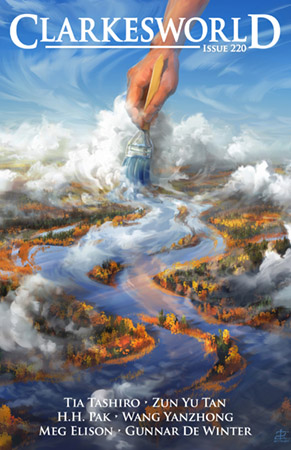
Novelette Review: “Strange Events at Fletcher and Front!” by Tom R. Pike

Analog Science Fiction & Fact, January/February 2025

George is an inventor in early 20th century New York. When the novelette opens, he is being chased by thugs he is certain were sent by one of the big energy barons (Rockefeller, Edison, or Frick) to abduct him. Just as the out-of-shape George runs out of steam, a strange, masked “intervenor” appears through a strange door and dispatches George’s would be abductors, using an impossible, futuristic energy weapon. Being a fan of H.G. Wells, George believes the intervenor to be a time traveler from the future. But has this person from the future prevented George’s abduction with good or evil intent? When George reads an obscure article suggesting that burning fossil fuels could have an adverse effect on global temperatures, he believes his rescuer meant for him to continue developing his “solar power generator” for mass production.

This is the second story in this issue of Analog, and the second to concern itself with climate change. I like that many such solution-based approaches to the subject matter are becoming commonplace in our oldest continuous science fiction publication. As for the story itself, it is of adequate quality: good character work, clear and concise prose, steady pacing. While plenty of obstacles in George’s way are referenced as the story progresses, we actually see little of it in action. The result is a story with a lot of conflict but little tension. While we might presume the mysterious time traveler achieved their goal, they never reappear, and the open ending perhaps suggests the author could revisit this alternate timeline in a future tale.

Short Story Review: “Our Lady of the Gyre” by Doug Franklin

Analog Science Fiction and Fact, January/February 2025

Mel, who narrates the story, sails a ship around the Pacific that submerges captured carbon in the ocean in the form of diatoms. The “Lady” referred to in the title is an orbiting artificial intelligence who sends warnings about potential weather disasters. Years before, Mel’s wife was killed during one such disaster. Now, another weather event looms just as Mel takes on two young deck hands to help on his latest drift around the gyre (a ring-like rotation of ocean currents).

There is quite a lot going on in the world of this story, and the way the author gradually broadens the scope and scale of its background is the story’s best attribute. Our Lady of the Gyre is one of several AIs that take on a mythological importance in this future, and are frequently the subject of poetry and performance art, a detail I enjoyed a great deal. The narrator also refers to a sort of information chaos brought on by a reliance on generative AI, making it difficult for society to distinguish between fact and falsehood, and I wish the author had utilized this idea a little more than he did. The characters are agreeable and well-drawn and the plot moves along at a steady clip, though is a little light on suspense and surprise.

Short Story Review: “When There Are Two of You: A Documentary” by Zun Yu Tan

Clarkesworld Issue 220, January 2025 (Story Link)

As the title suggests, this short story is structured as a series of interviews. The interviewees are all people who use, or have used, a new technology called Sentience, which is literally a digital copy of yourself, implanted in your own head to help make you a better you. The two main interviewees are Walter Lee II, the first Android built to house a sentience, who continues on after his original self dies; and Joyce Chu, who comes to believe her Sentience may not have all the answers.

This loosely structured story is surprisingly light on tension, especially considering the premise seems built for it. The final decisions that Walter II and Joyce make are understandable, but not surprising or particularly bold. Despite the intriguing concept, the whole package didn’t quite gel for me. Joyce’s final choice regarding her Sentience made me wonder if her Sentience was really the problem. It’s hard to be sure if that was the point.