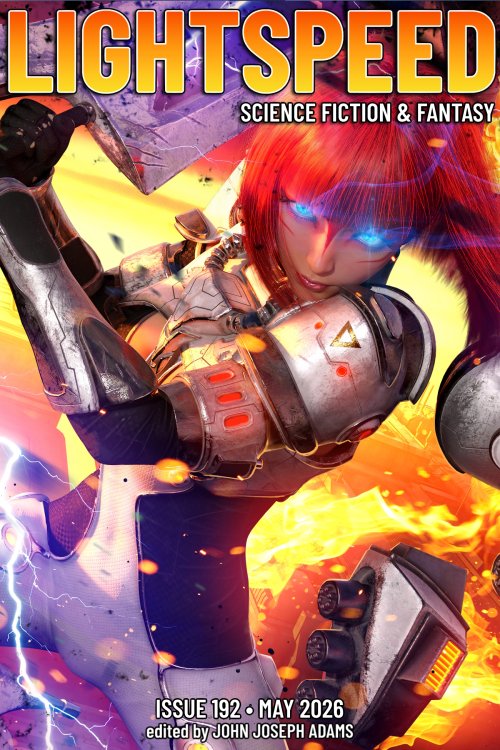
Short Fiction Review: Lightspeed Magazine – May 7, 2026 (Issue 192, Part 1)

“The Knacker Man” by Scott Dalrymple [1258 words]

Though slightly longer perhaps than what is usually considered flash fiction, “The Knacker Man” more resembles that form in that it is more of a vignette than a story. The protagonist, Moyer, is a WWI (presumably British?) soldier in France who finds the knacker man (who collects animal carcasses and repurposes/disposes of them) from his childhood haunting the woods near his trench.

The piece abides in liminality and has no interest in elucidating its ambiguities. This approach better serves the reader. The “why” of the knacker man’s presence in the woods is less important than appreciating Moyer’s state of mind when coming upon him. What the knacker man reveals about the future is better understood by the reader than by Moyer. I’m not sure if this piece came off as colder than the author intended or if coldness was the point.

“Sarah’s Laugh” Melissa A. Watkins [6488 words]

In this future United States, corporations have gained the autonomy of independent nations, building walls around “company towns” (and eventually large cities) and enslaving the people within. Inexplicably, the laugh of a child named Sarah makes the walls disappear, revealing the horrors within. The corporations and their Christian fundamentalist allies push back against this, of course.

The identity of the story’s narrator offers a surprising twist, and the framing device does a good job of bringing the proceedings into perspective for the reader. I found the story’s political messaging tendentious, rather than illuminating.

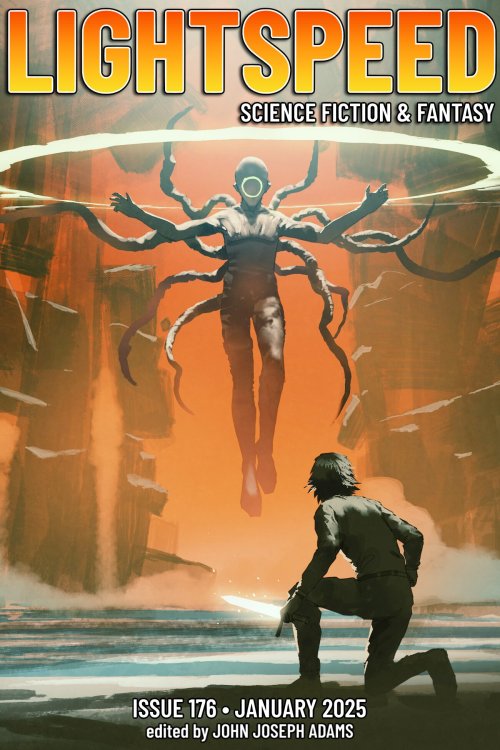
Short Story Review: “Tell Them a Story to Teach Them Kindness” by B. Pladek

Lightspeed Magazine Issue 176, January 2025 (Story Link)

Jude is working as a “Curator” for the Milwaukee school district, assigned to prompt new stories using an AI called RIGHTR. RIGHTR is designed to create stories that offer moral instruction without offending anyone. On a whim, Jude decides to send a 10th grade teacher a story written by a human author (Le Guin’s “Omelas”), assuming – correctly – that like most people this teacher, Booker, has never read a real book and wouldn’t know what it was. The story is a hit with the kids and Jude keeps passing off human-authored stories as RIGHTR-authored prompts. The ruse works brilliantly, until it doesn’t.

The story is framed as a series of messages between Jude and Booker (as well as other’s in Jude’s orbit) and I felt this was a good format for telling this particular story. The contrast between the distinctive voices of the characters and the impersonal delivery mechanism is effective, and on-theme. The point of the story is to dramatize our present-day anxieties regarding the use of AI, as well as the alarming trend among parents (and increasingly compliant school boards) to censor anything that might “upset” their children. This story works well in fulfilling this objective, and Jude’s misconception about what made his deception successful is heartbreaking. However, in the end the story does not ask anything more of the reader than to agree with its own moral purpose. Ironic, if unintended.

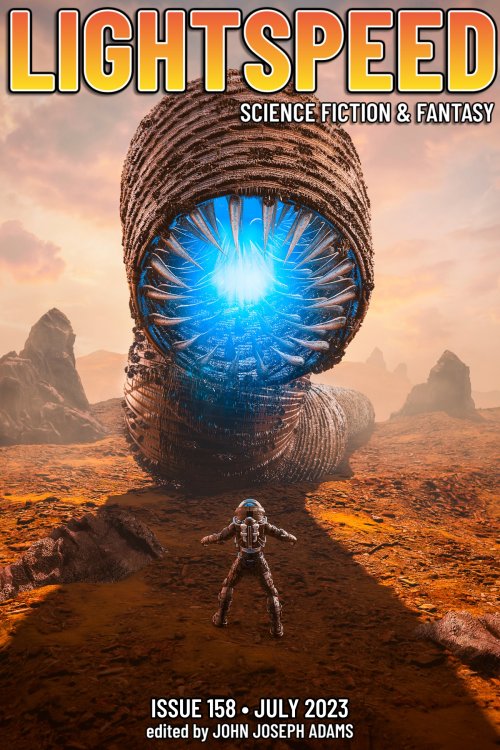
Short Story Review: “Death is Better” by Oluwatomiwa Ajeigbe

Lightspeed Issue 158, July 2023

The narrator of this story is trying – along with his little sister – to escape the alien slavers they were sold to by their own uncle, knowing that if they are caught the penalty is death. As the title of the story suggests, this would not be the worst outcome. This is a very short, relentlessly grim tale, but the author has a gift for building suspense and writing an exciting action scene. I thought the ending was a bit of a cheat (though it certainly fits with the story’s title/theme) and I could have used more engagement with the setting, but it is a well-written and exciting story nonetheless.