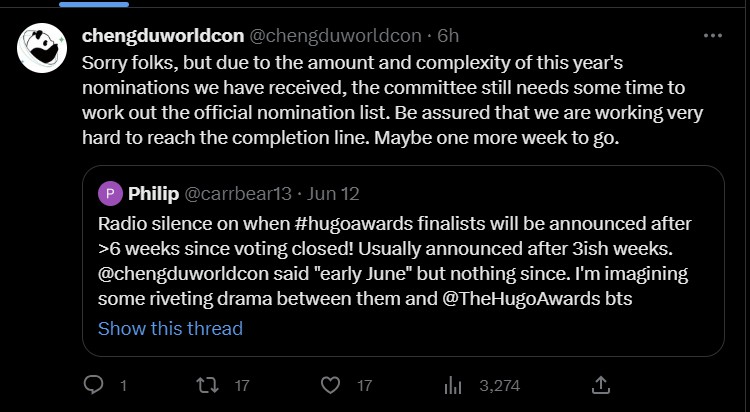
Hugo 2023 shortlist announcement delayed for “maybe one more week”

Chengdu Worldcon has finally given us an update on the Hugo shortlist announcement in the above quote tweet, though I would be surprised if there was any particularly “riveting drama” involved in the delay. Much of the frustration expressed here by Philip (and by many others) is the result of delays in this year’s voting process at the onset, coupled with the infrequency of updates from Worldcon itself. The opening of the nominating phase started much later than US and UK members are used to, with only roughly estimated target dates (much like the “early June” announcement Philip alludes to) to go on, which then passed by without any additional explanation from the committee. I’m sure Chengdu is just as frustrated by the delays as those of us in the states. In this new tweet, at least, there is some clue as to the cause of the delay.

The “amount and complexity of this year’s nominations” indicates that there may be a considerable number of Chinese works, authors and artists included on this year’s shortlist (I alluded to this possibility when making my predictions for the fiction finalists this year). It’s no secret that Chengdu Worldcon has made a concerted effort to encourage participation from Chinese fans in the nominating phase. The delays in the start of nominations was likely due to producing a unified system that accounted for the needs of both English-speaking and Chinese-speaking voters. I imagine similar issues plague the committee now. In particular, the requirements for the fiction differ somewhat in China from those in the English-speaking world so perhaps there is a need for greater scrutiny of eligibility, with more votes than usual needing to be moved from one category to another. It is also possible that there is some confusion in the eligibility requirements for the fan and professional categories. At the very least, getting the shortlist right and tailoring the announcement to both English-speaking and Chinese-speaking fans would necessitate additional time and resources. This is all speculation, as I don’t have any inside information on the matter, but my best guess is that all the “riveting drama” Philip jokingly imagines taking place is more likely just a bunch of extra headaches the committee is dealing with this year.

I sincerely hope these delays mean that there will be a number of Chinese authors and works on the shortlist. I have long hoped for greater participation in the Hugo process from non-US fans. There is a large enough contingent of UK-based fans participating from year-to-year to get some (but not many) UK authors on the ballot. African authors, in particular Nigerian authors, have begun appearing on Hugo and other shortlists, but have done so in part because they write primarily in English, and have one less barrier (among many, to be clear) when breaking into American markets than authors who need to have their works translated to English to find a publisher.

Maybe, if it does turn out that several Chinese-language works end up on the Hugo shortlist, it will jump start a trend of more international participation in Worldcon and the Hugo awards. Or maybe it will just be a one-off and things will go back to normal next year. Either way, I’m more excited to see this year’s shortlist than I have been in awhile. I’ll just have to wait until sometime next week. Possibly. Fingers crossed.
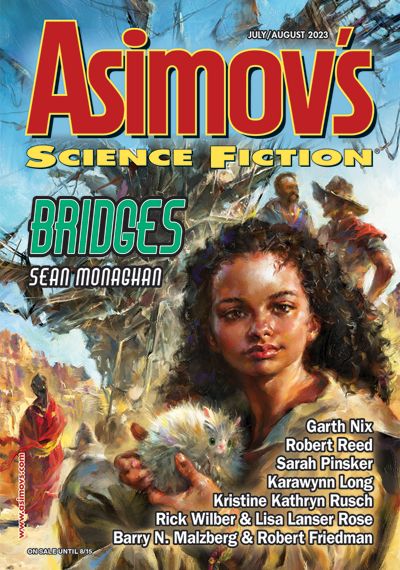
Novella Review: “The Death Hole Bunker” by Kristine Kathryn Rusch

Asimov’s Science Fiction, July/August 2023

“The Death Hole Bunker” starts a new storyline in Kristine Katherine Rusch’s Diving Universe, with some fascinating new additions to the mythology. Hogarth is mapping “death holes” that have been appearing underground on the planet Wyr for decades or more. The death holes always have mummified remains in them, and Hogarth always gets an uncomfortable, tingling feeling when he is near one. This time, there is no tingling feeling and he and his partner Raemi find a staircase leading to a series of rooms, suggesting someone once lived there. In one of the rooms is a treasure trove of rare and valuable items known as “ivory trees”, which are neither trees nor made of ivory. Rather they are branch-like objects made of an unknown material that no one has been able to replicate. And there are even stranger mysteries to uncover deeper in the bunker.

Of all the excellent worlds Rusch has gifted to the world, the Diving stories and novels are probably the most rewarding. This far far future, galaxy-spanning civilization is home to histories and technologies lost to the long march of time, unearthed by people with and incomplete understanding of their application, with often perilous outcomes. “The Death Hole Bunker” is as suspenseful and mysterious as any of the tales that came before. The only drawback is that this is one of those Diving stories meant to part of a longer work, so the long denouement acts a preview of things to come, leaving a lot of questions dangling with no closure for the reader. Of course I plan on reading the promised novel, but for now it leaves me with a tinge of bitterness on the back of my tongue for an otherwise excellent work of science fiction.

Novelette Review: “Imagine: Purple-Haired Girl Shooting Down the Moon” by Angela Liu

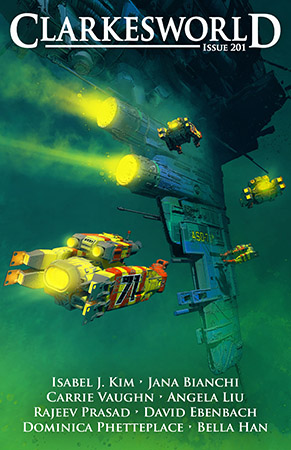
Clarkesworld #201, June 2023

I am always intrigued by science fiction stories about art. Especially in the now times, when new technology (NFTs, generative AI) are reshaping our ideas of how art objects will manifest in the future, with all the attending controversies and concerns. AI prompts are a part of what Angela Liu explores in this story (the title itself being one such prompt), but the goings on mostly focus on a technology called “NC orbs”, in which the artist can “paint” fresh memories into the mind of the user. Strapped for cash, the narrator of the story agrees to illegally paint an NC orb for a client of the brothel she sometimes works at, and consequences ensue. Liu has created quite a detailed cyberpunk dystopia here, though one so relentlessly grim it flirts with absurdity. Quite early in the story it is obvious this is all spiraling toward unavoidable tragedy. Despite this, the characters are compelling, and the author’s engagement with the story’s themes coheres quite nicely.

Short Story Review: “Vast and Trunkless Legs of Stone” by Carrie Vaughn

Clarkesworld #201, June 2023

Carrie Vaughn’s latest is a first contact story, one that takes a scenario used hundreds of times before, then adds a rather unusual and ingenious wrinkle that makes for a thoughtful and exciting read. The protagonist, Mal, is chosen for the one-on-one meeting with a representative of a newly arrived alien race known simply as the Mapmakers. Mal is chosen because the Mapmakers insist on meeting with someone who is not in any way a “leader”, and the Mapmaker Summit Committee decided Mal was the best choice because, “she’s kind, she listens, and everyone likes her”. Mal is rehearsed and fed a lot of talking points they want her to cover (the usual stuff about technology, etc.). But the Mapmaker representative has a different idea of how they want the conversation to go. Vaughn, one of the most efficient storytellers in SFF, offers just the right amount of buildup before throwing the reader a curveball, one that is by turns intriguing, understandable, and kind of hilarious. I really enjoyed the effort Mal and the Mapmaker put into trying to have a natural conversation, even while many of the nuances in such an exchange are difficult to delineate. Another excellent story from a genuine pro.

Short Story Review: “The Officiant” by Dominica Phetteplace

Clarkesworld #201, June 2023

“The Officiant” is in some ways an old-fashioned “sensawunda” SF tale, though one tempered by more modern understandings about cultural identity and colonialism. The author has created a vivid and complex world with a fascinating history and mythology. The narrator, a human born to Christian missionaries on the planet Raxia, has come to the planet Tau to officiate a wedding. The narrator quickly learns that the inhabitants of Tau, an enigmatic mechanical race called the Strangers, have a different motive altogether for inviting them there. The strength of the story is the way it gradually deepens our understanding the three cultures and how they view each other and how their competing needs, and mythologies, might set them at odds. Much of how the story unfolds is revealed in interactions between the narrator and the Raxian diplomat who accompanies them to Tau, limiting the amount of tension and excitement the author can build. The plot felt a bit slighter than I hoped it would be, but I would not at all mind seeing this world expanded in a longer work.

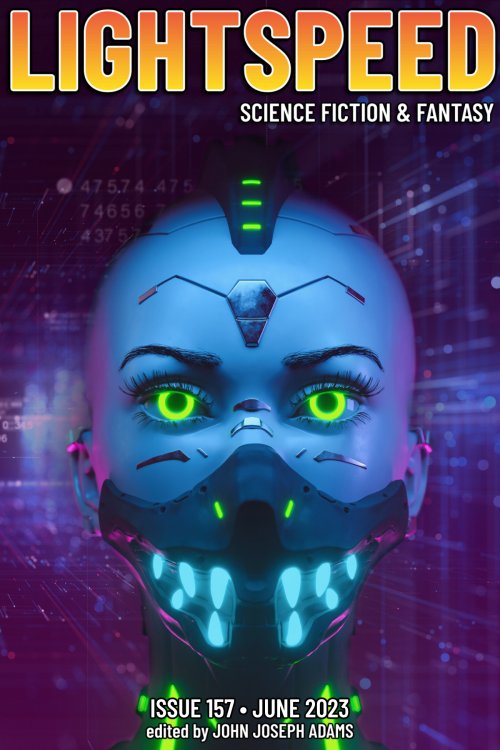
Short Story Review: “Spaceship Joyride” by Dominique Dickey

Lightspeed #157, June 2023

The first science fiction tale from June’s issue of Lightspeed is a pleasantly written queer coming-of-age story. The protagonist (related in the 2nd person) goes on the titular joyride with classmate crush Eddie, unsure if he is in the friend zone or not. Just as that is about to get cleared up, they are pulled over by a cop, and some mild tension ensues. The story is written in a clear style, and the protagonist and Eddie are both likeable characters. The story is ostensibly SF (spaceships, etc.) but it doesn’t need to be. It could be a story about two kids who hotwire a car and go for a joyride on the highway and it would be the same story with different tropes. As a coming-of-age tale it is well-meaning but nothing really sets it apart.

36 Streets wins the Aurealis award for best SF novel

One of my favorite SF novels of last year, 36 Streets by T.R. Napper, won the Aurealis award for best SF novel. If you haven’t read it, do so. It’s a cyberpunk thriller set in a Chinese-occupied Hanoi. In the midst of a turf war between rival crime syndicates, gangster Lin Vu is ordered to find a missing game designer responsible for an addictive VR game called Fat Victory, in which the player lives out the American War in Vietnam as an American soldier. The game is doing a serious number on the brains of people who play it, and Lin’s boss suspects the Chinese army is behind its distribution. The novel is almost wall-to-wall action, but still manages a degree of sophistication akin to the best cyberpunk works of the last few decades. The long sequence in which Lin immerses herself in Fat Victory is visceral and memorable.

I’ve only read one other work among the Aurealis finalists – the Garth Nix story from Tor.com – but some of the other novels are available on Amazon and a few of the short works are available online. Definitely pick up 36 Streets, but don’t be afraid to dabble in the other finalists as well. Australian SF isn’t terribly well-publicized here in the U.S. and rarely shows up on the Hugo or Nebula shortlists, but it never hurts to see how the other side of the world dreams.

You can view the full list of Aurealis winners and finalists here.

Novel Review: Translation State by Ann Leckie

Orbit Books; June 6, 2023

Rating: 2.5 out of 5.

Ann Leckie’s latest novel is a standalone effort set in her award-winning Ancillary universe, though the term standalone should come with a caveat anytime it refers to a part of an already established canon. Translation State, like the previous standalone Provenance, offers an expanded understanding of the world Leckie established in her Radch trilogy, but probably shouldn’t be thought of as an entry point to the universe. It is also, for me, the least successful of Leckie’s novels, though seemingly still an essential one for her readers, as it delves into several aspects of the earlier novels that were left ambiguous or incomplete.

The novel begins with three separate storylines that converge as the novel progresses. It kicks of with Enae, whose Grandmaman and sole benefactor has recently died. Enae finds hirself disinherited upon learning that Grandmaman had essentially been broke, and only managed to keep herself and Enae afloat by trading her estate and the family name to a nouveau riche upstart for a sizeable personal allowance. Luckily for Enae, Grandmaman had cooked up an agreement with this interloper to provide for hir (Enae) after her passing. So Enae is secured a position at the Office of Diplomacy, and sent on a errand to find out the whereabouts of, or to learn the ultimate fate of, a long missing Presger Translator. (For the uninitiated, the treaty with the alien Presger is the only thing keeping human civilization from crumbling, and the Translators – an engineered race of people separate from the Presger themselves – are essential to the treaty’s continued health.) Enae quickly learns that sie is not expected to actually complete the assignment, but simply to travel about and report back hir lack of success in doing so. Sie decides to make a go of it, anyway.

The other two threads follow Reet, an orphan who gets caught up in the machinations of a political faction of displaced people known as the Hikipi, and Qven, an adolescent Presger Translator who is considered damaged goods after suffering a terrifying sexual assault. Explaining how the plot brings these disparate individuals together would spoil to much, though it quickly becomes clear that the confluence of circumstances has far-reaching implications for the upcoming Conclave, which was aggressively teased in Provenance and given even more weight here.

Translation State has many of the attributes that won Leckie her loyal fan base: the social and political maneuverings; her tart, sometimes goofy sense of humor; the imaginative perils and pitfalls she throws in her characters’ paths. We get to learn more about the the Geck and the Rrrrrr, and especially the thoroughly fascinating Presger Translators, even if the Presger themselves are still shrouded in mystery.

Where Translation State falls short for me – and it’s a pretty big fall – is in the three main characters themselves. Our introduction to Enae, who seemingly spent hir life up until Grandmaman’s death showing no real initiative or assertiveness (at least, not that we are made aware of) does nothing but when the plot requires sie do so, with little indication of what might have brought about this sea change. That sie fades somewhat into the background as Reet and Qven take center stage is not surprising. Those two characters, whom the main action of the novel is visited upon, are impossibly earnest, cloying in their preciousness – much in the way adults idealize adolescence, rather than being believably adolescent (a common problem in many YA novels). Not to mention (sorry if this is too spoilery) a big chunk of the novel deals with their growing bond of friendship, which consists entirely of them lying in bed and binge-watching a streaming show. This is a growing trend in science fiction – the lionizing of modern-day consumerist habits in a far-future setting – and until now I would have hoped an author of Leckie’s considerable gifts would steer clear of it, but here we are.

As a harbinger of things to come, Translation State gives readers plenty to look forward to, but for this reader, at least, less to hold onto right now.