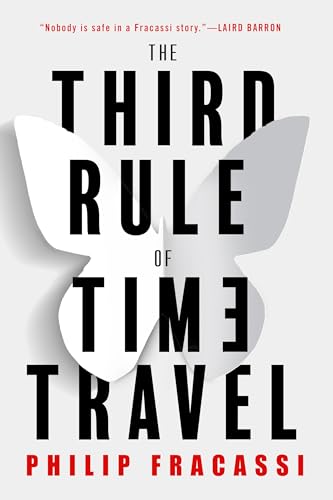
Novel Review: The Third Rule of Time Travel by Philip Fracassi

Rating: 5.5 out of 10.

The title of this novel is a marketing department’s dream come true. It’s the kind of title that tells potential readers what the book is about without them even having to read the synopsis. The book is about time travel (obviously). There are rules to traveling through time and the third one is clearly important, and, by implication, will almost certainly be broken. The butterfly (effect) on the cover is also a nice piece of foreshadowing. I fully admit that I judged this book by its cover before I even opened it.

What actually occurs between those covers is a bit of a mixed bag. The premise is straightforward enough: Beth Darlow is a physicist who, along with her late husband Colson, invented a machine that can transport a person’s consciousness back in time to an earlier point in one’s life, where according to the infamous third rule, one can only observe said past event, but cannot affect it. Beth is the only one who is allowed to use the machine, and upon returning from one of her trips she must answer an identical set of questions – and hopefully give an identical set of answers – to those asked before the she activated the machine, to ensure the third rule has held true. Beth also has a sufficiently adorable daughter, Isabelle, who she loves deeply but neglects too often in favor of her work, and an insufferable boss who is trying to get her sidelined from the project. Additionally, there is the question of why Beth’s trips are only sending her back to her most traumatic memories, specifically the plane crash that she survived as a child while her entire family perished, and the night her husband died in a car accident. These elements provide ample dramatic tension to carry the reader’s interest through much of the novel.

The biggest problem with the novel is that most lay, non-scientist persons are already aware of the “observer effect”, so the fact that none of the scientists in the story (least of all Beth) points out the fundamental absurdity of relying on this untenable third rule that threatens their very existence is baffling. The novel’s big twist relies entirely on this fallacy and leads to Beth’s Homer Simpson moment (“Doh! Why didn’t I think of this before!”), unintentionally acknowledging the very fatal flaw that undermines the novel’s premise from the start. Even for readers who were not aware of the observer effect when they picked up the book, the fact that the scientist protagonist fully admits to “forgetting” a fundamental principal that every scientist in the world is aware of is a problem that is difficult to look past.

My interest in the remainder of the novel deflated like a balloon after this. What had otherwise been a well-plotted story with solid, relatable characters turned into a bit of a letdown. Discovering that the answer to the one question that had been bugging me throughout the book – why is no one addressing the observer effect? – is that the author was just hoping I wouldn’t notice, is tough to overlook.

Novel Review: Translation State by Ann Leckie

Orbit Books; June 6, 2023

Rating: 2.5 out of 5.

Ann Leckie’s latest novel is a standalone effort set in her award-winning Ancillary universe, though the term standalone should come with a caveat anytime it refers to a part of an already established canon. Translation State, like the previous standalone Provenance, offers an expanded understanding of the world Leckie established in her Radch trilogy, but probably shouldn’t be thought of as an entry point to the universe. It is also, for me, the least successful of Leckie’s novels, though seemingly still an essential one for her readers, as it delves into several aspects of the earlier novels that were left ambiguous or incomplete.

The novel begins with three separate storylines that converge as the novel progresses. It kicks of with Enae, whose Grandmaman and sole benefactor has recently died. Enae finds hirself disinherited upon learning that Grandmaman had essentially been broke, and only managed to keep herself and Enae afloat by trading her estate and the family name to a nouveau riche upstart for a sizeable personal allowance. Luckily for Enae, Grandmaman had cooked up an agreement with this interloper to provide for hir (Enae) after her passing. So Enae is secured a position at the Office of Diplomacy, and sent on a errand to find out the whereabouts of, or to learn the ultimate fate of, a long missing Presger Translator. (For the uninitiated, the treaty with the alien Presger is the only thing keeping human civilization from crumbling, and the Translators – an engineered race of people separate from the Presger themselves – are essential to the treaty’s continued health.) Enae quickly learns that sie is not expected to actually complete the assignment, but simply to travel about and report back hir lack of success in doing so. Sie decides to make a go of it, anyway.

The other two threads follow Reet, an orphan who gets caught up in the machinations of a political faction of displaced people known as the Hikipi, and Qven, an adolescent Presger Translator who is considered damaged goods after suffering a terrifying sexual assault. Explaining how the plot brings these disparate individuals together would spoil to much, though it quickly becomes clear that the confluence of circumstances has far-reaching implications for the upcoming Conclave, which was aggressively teased in Provenance and given even more weight here.

Translation State has many of the attributes that won Leckie her loyal fan base: the social and political maneuverings; her tart, sometimes goofy sense of humor; the imaginative perils and pitfalls she throws in her characters’ paths. We get to learn more about the the Geck and the Rrrrrr, and especially the thoroughly fascinating Presger Translators, even if the Presger themselves are still shrouded in mystery.

Where Translation State falls short for me – and it’s a pretty big fall – is in the three main characters themselves. Our introduction to Enae, who seemingly spent hir life up until Grandmaman’s death showing no real initiative or assertiveness (at least, not that we are made aware of) does nothing but when the plot requires sie do so, with little indication of what might have brought about this sea change. That sie fades somewhat into the background as Reet and Qven take center stage is not surprising. Those two characters, whom the main action of the novel is visited upon, are impossibly earnest, cloying in their preciousness – much in the way adults idealize adolescence, rather than being believably adolescent (a common problem in many YA novels). Not to mention (sorry if this is too spoilery) a big chunk of the novel deals with their growing bond of friendship, which consists entirely of them lying in bed and binge-watching a streaming show. This is a growing trend in science fiction – the lionizing of modern-day consumerist habits in a far-future setting – and until now I would have hoped an author of Leckie’s considerable gifts would steer clear of it, but here we are.

As a harbinger of things to come, Translation State gives readers plenty to look forward to, but for this reader, at least, less to hold onto right now.