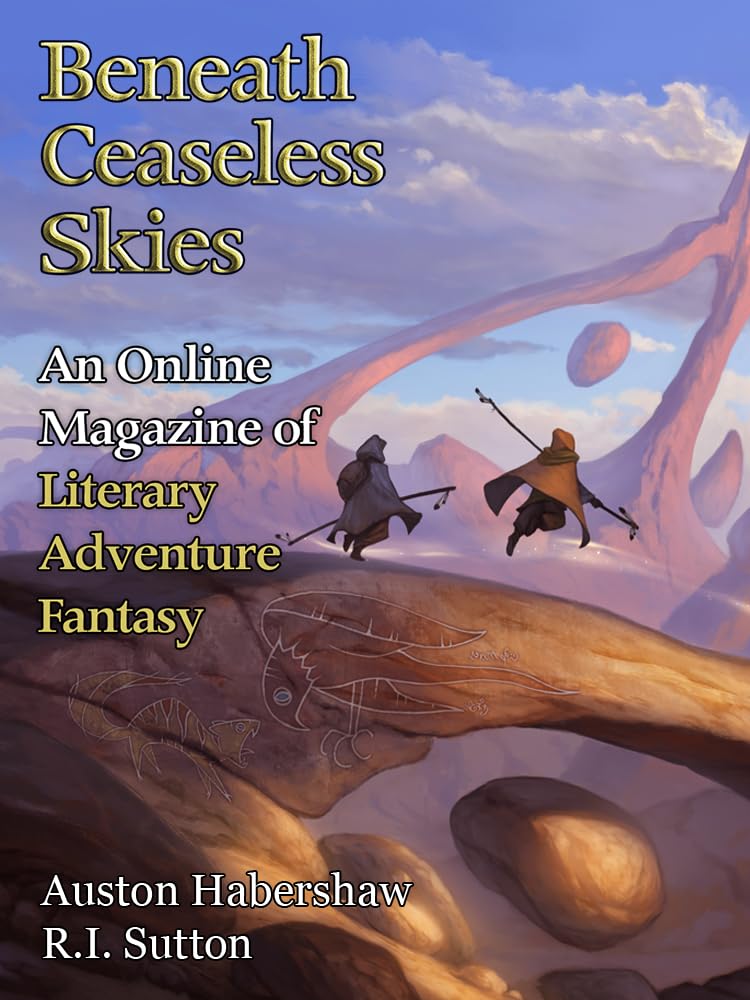
Short Fiction Review: Beneath Ceaseless Skies Issue 457

“Slayer of Dreams” by Auston Habershaw [12520 words]

In the city of Avissos, the Onierarch, or Dream Tyrant, taxes the dreams of its citizens whether asleep or awake. By day the city exists solely to witness glorious arena battles between champions and gorgons – monsters of fire and steel. The barbarian witch Katatha returns to the city for revenge, years after escaping enslavement by the Dream Tyrant. She intends to use the city’s greatest champion, Hargeas, as her tool against her enemy in hopes of freeing the people of the city from its grasp.

Habershaw is a sturdy and seasoned SFF author, and this shows in both the elements of his worldbuilding and steadily rising tension of the narrative. Grotesque details like the shape-changing, fire-spitting gorgons; the creepy way the Onierarch puppets its adherents; the bottles of “champion sweat” people hang around their necks or on doorframes as talismans. Ultimately, I couldn’t decide if I wanted the piece to be longer or shorter, to revel in its minutia or tell a tighter, terser story. Perhaps it falls just short of balancing the two. Otherwise, a solid and imaginative tale.

Wilhelm Strong is a glassblower and member of the þrælar, the lowest caste in the floating city of Himinheim. Everyone living on the bottom level of the city has a “corpse door” for fishing and disposing of corpses (!), which happens all too frequently. One day, a man from the highest caste comes to Wilhelm’s workshop to commission some oddly shaped vials, and sometime after this, þrælar begin disappearing through their corpse doors, with authorities claiming it to be an epidemic of suicides. Wilhelm’s apprentice sees a conspiracy afoot and is able to convince Wilhelm to entertain his suspicions, with tragic results.

The story begins with a lament, indicating the story we are about to read is from a message-in-a-bottle. We know from the start this won’t end well and are reminded of this with each shocking and violent turn of events in the final act. Even with the inevitable dissolution of Wilhelm’s efforts to uncover the truth and save his people, the author constructs a suspenseful and emotionally wrenching narrative. This could have been a little shorter and tighter (yes, I always say that) but it never lost my attention.

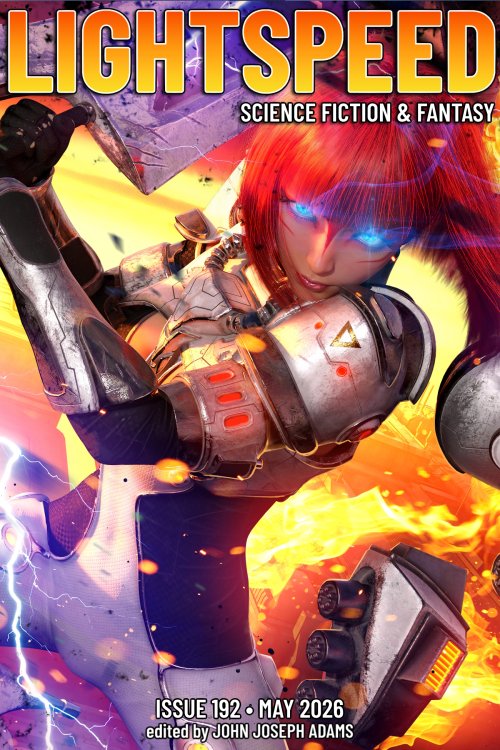
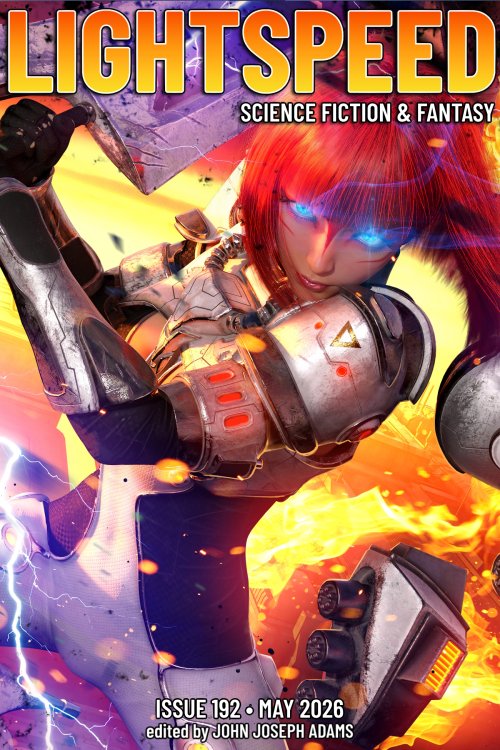
Short Fiction Review: Lightspeed Magazine – May 14, 2026 (Issue 192, Part 2)

“The Star Where We Meet” by Sam W. Pisciotta [3435 words]

The digitized consciousness of a formerly living man sent 125 light years away on a “quantum chip” to convene with an alien intelligence meets in person a digitized representation of the son he only had in the digitized dreamworld during his trip, where he made different choices from the ones he made in his real life.

A clever idea, but for me it was not as emotionally engaging as the author wants it to be. I think the two characters spend too much time just trying to hash out if their relationship was real and meaningful to convince me that it was.

“The Aerialist” by Yoon Ha Lee [1144 words]

Kallista, the aerialist of the title, has been barred from flight. She steals a faerie typewriter from the Museum of Curioddities (heh), hoping to fence it and buy back her commission. When she’s discovered by a guard, the typewriter offers her a novel (pun intended) solution for escape.

A really fun, if slight, little story, buoyed by the author’s trademark idiosyncrasies and taut compositions.

Short Fiction Review: Lightspeed Magazine – May 7, 2026 (Issue 192, Part 1)

“The Knacker Man” by Scott Dalrymple [1258 words]

Though slightly longer perhaps than what is usually considered flash fiction, “The Knacker Man” more resembles that form in that it is more of a vignette than a story. The protagonist, Moyer, is a WWI (presumably British?) soldier in France who finds the knacker man (who collects animal carcasses and repurposes/disposes of them) from his childhood haunting the woods near his trench.

The piece abides in liminality and has no interest in elucidating its ambiguities. This approach better serves the reader. The “why” of the knacker man’s presence in the woods is less important than appreciating Moyer’s state of mind when coming upon him. What the knacker man reveals about the future is better understood by the reader than by Moyer. I’m not sure if this piece came off as colder than the author intended or if coldness was the point.

“Sarah’s Laugh” Melissa A. Watkins [6488 words]

In this future United States, corporations have gained the autonomy of independent nations, building walls around “company towns” (and eventually large cities) and enslaving the people within. Inexplicably, the laugh of a child named Sarah makes the walls disappear, revealing the horrors within. The corporations and their Christian fundamentalist allies push back against this, of course.

The identity of the story’s narrator offers a surprising twist, and the framing device does a good job of bringing the proceedings into perspective for the reader. I found the story’s political messaging tendentious, rather than illuminating.

Hugo voting is open! The voter packet is here!

Yesterday I saw a post from Scalzi pushing back at some rando who claimed Hugo voters don’t read all the nominated works. I wanted to be mad about it too, because dammit! I definitely try!

The truth is, Best Series always gets sacrificed because the Best Novel and Novella finalists always push me up to the voting deadline. And this year may be no different, as I need to read four of the six novels and all six novellas. For three of the Best Series finalists, I have read some or all of the novels (White Space, Old Man’s War, Chronicles of Osreth), and for the other three I will try to read the first novel in the series, time permitting.

Time permitting means that in addition to all this Hugo reading between now and the August 8 deadline, I also have at least ten other books I want to read (new books from Mark Lawrence, Fonda Lee, Martha Wells, Ann Leckie, Ray Nayler, Suzanne Palmer, James Cambias, Adrian Tchaikovsky, Temi Oh, Wil McCarthy, yikes! it’s quite a summer and I want to get through at least half of these before the fall books start arriving) as well as three new issues each of Clarkesworld and Lightspeed, seven new Beneath Ceaseless Skies, two each of Uncanny, Analog and Asimov’s, and of course near weekly entries from Reactor. Also, I will want at least a few days to go through the material for all the other categories in the packet. (BTW I have already read all the short stories and novelettes except When He Calls Your Name and Laser Eyes Ain’t Everything but I’m not too worried about fitting those in. I’ll probably just read them tonight).

So, here is my order of operations for Hugo boot camp:

  1. The Raven Scholar – It’s the longest of the novels so it makes sense to read it first. It’s also the one I’ve most wanted to read even before the nominations came out.
  2. The Everlasting – I liked The Ten Thousand Doors of January and A Spindle Splintered. Not an author that jumps to the top of my TBR but I anticipate enjoying this.
  3. The Incandescent – Liked but didn’t love Some Desperate Glory. I know, sacrilege. Also think this will be good.
  4. Death of the Author – Probably avoided this because the title reminded me of having to slog through the Roland Barthes essay in Literary Theory class a lifetime ago. Despite Nnedi Okorafor’s attempt to re-traumatize me I think I will survive this.
  5. Murder by Memory – I have never read anything by this author, but I do love a good murder. Fictional murder. Fiction.
  6. What Stalks the Deep – Terrific writer, really good series.
  7. The River Has Roots – I’m hit-and-miss with this author. Here’s hoping for a hit.
  8. Cinder House – I have not read this author. She was previously nominated in the Best Series category but as usual I did not get to it before the deadline.
  9. Automatic Noodle – This looks “cozy”, which I am generally allergic to. Doesn’t mean I will hate it, but it does drop it closer to the bottom of the pile.
  10. The Summer War – This is only available as an excerpt in the voter packet, so I will have to get it at the library. This will move it up or down the list depending on when it is available for checkout. I like Novik a lot, so this is one of the more anticipated titles in the queue.
  11. Rosemary and Rue – The saga of me trying to read this book continues. Every time this series gets nominated I want to read this novel and I never manage to make it before the deadline. Maybe this year things will work out.
  12. Dead Country – I’ve read a few of Gladstone’s Craft Sequence novels but not this spinoff series. It is a pretty short novel so if I can get through no. 11, I may be able to squeeze this in.
  13. Emily Wilde’s Encyclopaedia of Faeries – Only an excerpt in the packet, but FFS the excerpt is like half the novel why not just include the whole thing? We’ll see if I make it this far.

Happy reading, Hugo voters!
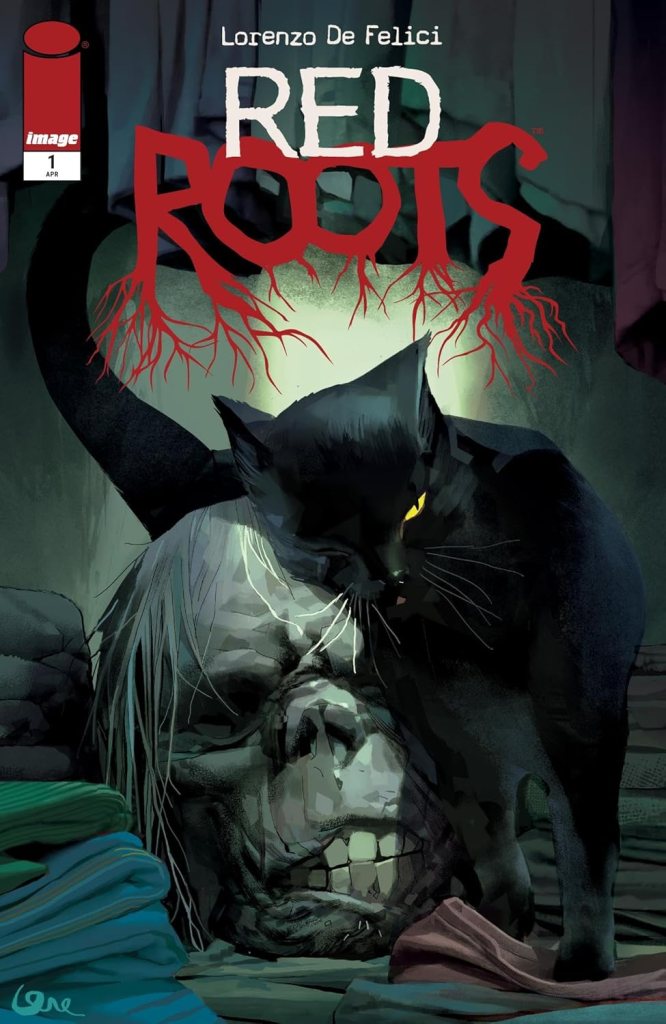
New Comics Review: Red Roots #1 by Lorenzo De Felici (Image Comics)

Rating: 9 out of 10.

Red Roots is a new horror thriller comic that follows two parallel, but seemingly unconnected storylines. It begins with a man, later revealed to be a mercenary, codenamed Sands, for the formidable Delta Agency, who busts into a building and bashes, slices, and otherwise ventilates a succession of goons as he makes his way upstairs with a polaroid photo of a woman in his pocket. The intertwining story follows lonely science teacher Katie, who finds a severed head in her closet and comes to believe her mind is unraveling, just like her mother before her.

Like any good first issue, writer/artist De Felici doesn’t overburden the reader with story points, instead focusing on inciting incidents and establishing character motivations that promise an intriguing yarn to come. Accordingly, his narrative approach is economical. Sands’ part of the issue has a noir-ish feel to it – shadowy, high-contrast, with color tones shifting from blood red to sterile blue to intense green, highlighting shifts in mood and pacing. Action is clipped in short bites, even as the panels themselves are wonderfully gothic and expressive. The base tone for Katie’s story is softer, almost beige, but slips into foreboding dark blues and tenser greens as her previously uneventful life slides into confusion and terror.

Despite only offering hints at the story to come, the issue concludes with a couple of wild twists (one of which indicates the meaning of the comic’s title) that send the two characters off in unexpected directions. Curiously (and welcomely), De Felici resists the urge to explain how the two disparate storylines connect, which is perhaps the most enticing mystery of all.

I will pick this one up again, and I anticipate reviewing the first trade when it is published in November.

Short Fiction Review: Beneath Ceaseless Skies Issue 456

“The Sparrow Tree” by Alma Alexander [3308 words]

The Padishah Emperor is a lover of life and nature, and wants his successor, the Young Emperor, to follow in his footsteps. The Young Emperor is obsessed with how things function, rather than appreciating the beauty of life as his father does. When the Young Emperor is elevated to Padishah, he begins fashioning mechanical replacements for various flora and fauna. In particular, his predecessor’s beloved Sparrow Tree is embedded with glistening jewels and populated with mechanical sparrows instead of real ones.

This story is written in “fairy tale” or “fable” mode and is related in broad strokes rather than concentrated actions and intimate moments. I was never really engaged with the Young Emperor’s personal journey, since the narrative seems to skip over whatever events or introspections occurred in his life that inform his change in perspective at the end. I think the author assumed the reader would see his transformation as self-evident and fill in the blanks. The use of the term Padishah suggests a Persian or Ottoman connection, but the detail has little bearing on the proceedings.

“Song, Skin, Sea” by Tamara Vardomskaya [6394 words]

Beneath Ceaseless Skies editor Scott H. Andrews likes to pair stories thematically in each issue, and “Song, Skin, Sea” is a selkie story, so it also has the comportment of a fairy tale. Unlike “The Sparrow Tree” though, it offers a more complete disclosure of the life of its protagonist. As a child, Margalita is stolen from the sea (and her mother) and taken to the court of Count Henrikov, who has her trained as an opera singer and eventually marries her (not that she had a choice in the matter). While touring the world, she takes her harpist Bellis as her lover and abandons her husband – and children – for good. The story is told in flashbacks while she and Bellis, much older and badly injured, are barely surviving on a rowboat at sea after a shipwreck.

Like a lot of modern day selkie stories, the author both subverts and fulfills the conventions of the genre. The character details are conveyed honestly and earnestly, distinguishing it from others of its kind I have read in recent years. This is mostly an enjoyable story, if unevenly paced.